
In the modern digital ecosystem, the “low battery” notification is a universal pain point. For decades, we have been tethered to wall outlets by tangled copper wires. However, a silent revolution is happening on our nightstands, office desks, and even inside our furniture.
Wireless charging—once a futuristic concept—is now a global standard. But how does it actually work? Is it safe for your battery? And how are companies like Honghao Electronics pushing the boundaries with technologies like Under-Desk (Long-Distance) Charging and custom PCBA solutions?
In this comprehensive guide, we explore the physics, hardware, and future of cable-free power.
1. The Science of Silence: How Wireless Charging Works
To understand wireless charging, we must look at Electromagnetic Induction. This isn’t new technology—Michael Faraday discovered the principles in the 19th century—but modern electronics have refined it into a high-efficiency tool.
The Physics of the Coil
At its simplest, wireless charging involves two induction coils:
The Transmitter (Tx): Located inside the charging pad or furniture.
The Receiver (Rx): Located inside your smartphone, wearable, or power bank.
When an alternating current (AC) passes through the transmitter coil, it creates a fluctuating magnetic field. When you place a compatible device on the pad, this magnetic field induces an electrical current in the receiver coil, which is then converted into DC power to charge the battery.
The Role of the PCBA (The “Brain”)
While the coils do the heavy lifting, the PCBA (Printed Circuit Board Assembly) is the intelligence behind the operation. At Honghao Electronics, our engineering team focuses on:
Frequency Regulation: Ensuring the charging stays within the 110-205 kHz range (for Qi standards).
Foreign Object Detection (FOD): Identifying if a coin or key is on the pad to prevent overheating.
Thermal Management: Throttling power to protect the longevity of the device’s lithium-ion battery.
2. Evolution of the Standard: From Qi to Qi2 and Beyond
If you are sourcing wireless chargers for an international market, understanding the Wireless Power Consortium (WPC) standards is vital.
The Qi Standard
Most devices today use the Qi standard. It ensures that a Honghao charger will work perfectly with an Apple iPhone, a Samsung Galaxy, or a Google Pixel.
Magnetic Alignment (Qi2)
The newest evolution, Qi2, incorporates magnets (similar to Apple’s MagSafe). This solves the #1 problem users face: Misalignment. If the coils aren’t perfectly centered, energy is lost as heat, and charging speeds drop. Our latest multi-functional charging stations utilize high-grade N52 magnets to ensure 99% alignment accuracy every time.
3. Breaking the Surface: Under-Desk (Long-Distance) Charging
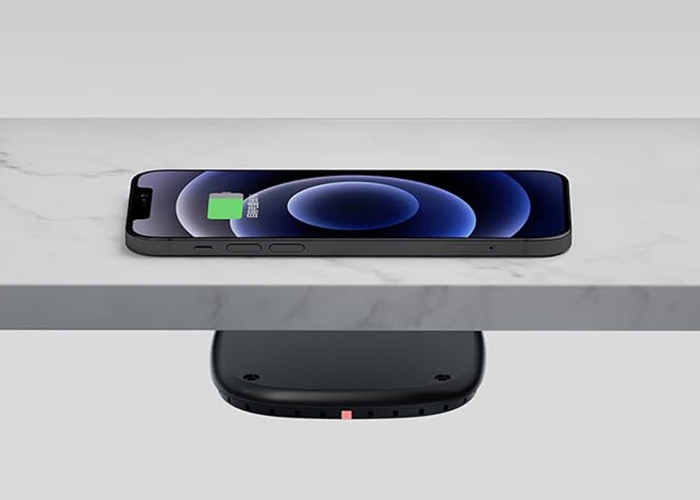
Standard wireless charging requires “contact.” But for a truly “invisible” aesthetic, Long-Distance Wireless Charging is the gold standard for high-end office fit-outs and hospitality.
How Under-Desk Charging Differs
Traditional chargers have a sensing distance of 3mm to 8mm. Honghao’s specialized Under-Desk Chargers utilize high-density coils and boosted PCBA power stages to penetrate surfaces (wood, marble, glass) up to 25mm–35mm thick.
Technical Challenges We Solved:
Eddy Current Suppression: Preventing the table surface from heating up.
Stable Resonance: Maintaining a consistent charge even through thick materials.
Installation Ease: No drilling required—keeping the furniture’s integrity intact.
4. Why PCBA Manufacturing Power Matters
For B2B clients and wholesalers, the “outer shell” of a charger is just plastic. The true value lies in the PCBA production.
At Honghao Electronics, we don’t just assemble; we manufacture.
SMT (Surface Mount Technology) Precision: We utilize high-speed Siemens and Yamaha SMT lines to ensure every capacitor and IC is placed with micron-level accuracy.
Multi-Layer Board Design: To make devices like our Multi-functional Power Strips compact, we design 4-layer and 6-layer PCBs that handle high voltage (AC) and low voltage (DC Wireless) in the same small footprint without interference.
Quality Control (QC): Every board undergoes AOI (Automated Optical Inspection) and load testing before it enters a casing.
5. Daily Use Cases: Enhancing the User Experience
To market these products effectively on your independent site, you must connect the tech to the lifestyle.
The Home Office
The Multi-functional Wireless Charging Power Strip is the ultimate desk organizer. By integrating AC outlets for laptops, USB-C PD (Power Delivery) for tablets, and a wireless pad for phones, it eliminates “cable chaos.”
The Travel & Commute
Wireless Power Banks have evolved. No more carrying a lightning or USB-C cable that might fray. With built-in magnetic wireless charging, the power bank “sticks” to the phone, allowing for seamless use while walking or taking photos.
Hospitality and Public Spaces
Cafes and hotels are increasingly installing Hidden Wireless Chargers. It provides a “wow” factor for guests—they simply set their phone on a marked spot on the table, and it starts charging.
6. Addressing Safety: Is Wireless Charging Bad for Your Battery?
One of the most searched terms on Google is: “Does wireless charging ruin my phone?” As a technical leader, your blog must answer this honestly.
The Answer: No, if the thermal management is correct. Heat is the enemy of batteries. Cheap, uncertified chargers generate excess heat due to poor coil quality and inefficient PCBA design.
Honghao’s Solution: Our boards include NTC (Negative Temperature Coefficient) thermistors. If the temperature exceeds 40°C, the PCBA automatically reduces the wattage, protecting the device.
7. The Future: Higher Wattage and Greater Distances
The industry is moving from 15W toward 50W and even 100W wireless charging (mostly seen in proprietary smartphone ecosystems). However, for the universal market, the focus is on Efficiency and Versatility.
We are currently researching:
GaN (Gallium Nitride) Integration: Using GaN in our power strips to make them smaller and cooler.
Spatial Charging: Charging devices several meters away (still in the R&D phase globally).
8. Why Partner with Honghao Electronics?
In a crowded market, why do global brands choose us?
Vertical Integration: From the raw PCBA to the final packaging, we control the entire supply chain. This means better price-to-performance ratios for our partners.
R&D Expertise: Our engineers have over a decade of experience in power electronics. We don’t just follow trends; we solve technical hurdles like long-distance induction.
Certification Ready: Our products are designed to meet CE, FCC, RoHS, and Qi standards, ensuring smooth entry into European and American markets.
Customization (OEM/ODM): Need a wireless charger built into a specific furniture component? Our PCBA team can customize the board shape and coil size to fit your needs.
Conclusion: The Wire-Free World is Here
Wireless charging is no longer a gimmick—it is a sophisticated marriage of physics and electrical engineering. As we move toward a world without ports, the quality of the internal components becomes the deciding factor in consumer satisfaction.
Whether you are looking for a sleek Long-Distance Under-Desk Charger for a modern office or a reliable PCBA partner for your next electronic project, Honghao Electronics delivers the stability and innovation required for the 2026 market.