
The modern office has undergone a radical transformation. As professionals move toward a minimalist “Clean Desk” aesthetic, the traditional clutter of charging cables has become the final frontier of office organization. However, achieving a truly cable-free environment is not merely a matter of convenience; it is a complex engineering challenge.
At Honghao Electronics, our experience in PCBA (Printed Circuit Board Assembly) manufacturing has shown us that the “invisible” power revolution is driven by precise electronic design rather than just consumer-level gadgets. This article explores the transition from traditional tethered charging to integrated, under-desk wireless solutions.
1. The Core Technology: Magnetic Resonance vs. Induction
To understand how a phone charges through 30mm of solid wood, one must understand the difference between standard Qi-induction and Long-Distance Magnetic Resonance.
Inductive Charging: Requires tight alignment and near-zero distance.
Resonant Charging: Allows for a “charging zone” with a significant Z-axis (vertical) gap.
Honghao’s Technical Approach: Our team focuses on optimizing the Quality Factor (Q factor) of the induction coils. By using multi-strand Litz wires and high-permeability ferrite materials within the PCBA, we reduce skin effect losses at high frequencies, allowing power to penetrate thick non-metallic surfaces efficiently.
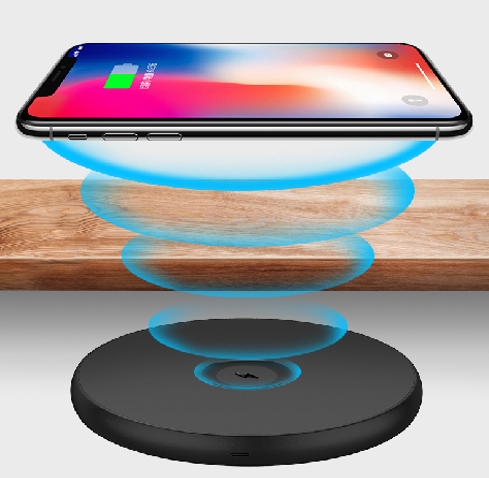
2. PCBA Engineering: The Critical Infrastructure
For a wireless charger to be reliable, the PCBA must handle three primary challenges: Thermal Management, Power Conversion Efficiency, and Safety Protocols.
A. Thermal Regulation (NTC Implementation) Wireless charging inherently generates heat due to eddy currents. In our PCBA production, we integrate multiple NTC (Negative Temperature Coefficient) thermistors. These sensors provide real-time feedback to the MCU (Microcontroller Unit), which dynamically adjusts the duty cycle of the PWM (Pulse Width Modulation) signal to keep temperatures within a safe 40°C range.
B. Foreign Object Detection (FOD) Safety is the cornerstone of Honghao’s manufacturing philosophy. Our PCBAs utilize a sophisticated differential voltage monitoring system. If a metallic object (like a paperclip or key) enters the magnetic field, the PCBA detects the abnormal resonance shift and terminates power transmission in milliseconds to prevent overheating.
3. Product Integration: From Power Strips to Portable Solutions
Our expertise extends beyond single-point chargers into integrated power ecosystems.
Multi-functional Wireless Power Strips: These units require a hybrid internal layout where High-Voltage AC circuitry and Low-Voltage DC wireless components coexist. We employ strict EMI (Electromagnetic Interference) shielding to ensure the AC switching noise does not degrade the wireless charging efficiency.
High-Density Power Banks: For portable wireless power, space is at a premium. We utilize HDI (High-Density Interconnect) PCBA layouts to fit high-capacity lithium polymer protection circuits and Qi-compatible coils into a slim, pocket-friendly form factor.
4. Manufacturing Excellence and Quality Control
As a dedicated electronics firm, Honghao Electronics maintains a rigorous production cycle that goes beyond simple assembly.
SMT (Surface Mount Technology) Precision: Our automated lines ensure that every MOSFET and capacitor is placed with micron-level accuracy, reducing the risk of cold solder joints.
AOI & Functional Testing: Every board undergoes Automated Optical Inspection (AOI) followed by a full-load aging test to simulate long-term usage in high-temperature environments.
Compliance: We design our circuits to meet global standards including CE, FCC, and RoHS, ensuring our B2B partners can export to any international market with confidence.
5. The B2B Advantage: OEM and ODM Capabilities
Working with a direct PCBA manufacturer provides professional buyers with a level of customization that traders cannot offer. Whether it is adjusting the charging distance for a specific furniture line or redesigning the port layout for a custom power bank, Honghao’s engineering team provides end-to-end support from schematic design to mass production.
6. Conclusion: The Practical Future of Power
The “Invisible Desk” is no longer a concept; it is a functional reality. By focusing on the underlying PCBA technology and thermal efficiency, Honghao Electronics is helping businesses and consumers transition to a cleaner, more productive environment.
Innovation at Honghao is not about flashy claims—it is about the steady, reliable performance of the components that power your daily life.