
Why Wireless Charging Gets Warm
Place your phone on a wireless charger, and the battery starts charging without a cable.
It feels simple.
But after a few minutes, you may notice something else:
Your phone or charging pad feels warm.
Is that normal?
Why does wireless charging generate heat when there is no physical electrical connection?
The short answer is energy loss.
Wireless charging transfers electrical energy through an electromagnetic field. During that process, not all of the input energy reaches the battery. Some energy is inevitably converted into heat.
But the amount of heat depends on much more than the fact that charging is wireless.
Coil design, alignment, distance, power conversion, materials, temperature, and control systems can all affect how efficiently energy is transferred.

Wireless Charging Doesn’t Transfer 100% of the Energy
Every energy conversion system has some degree of loss.
With wired charging, electrical energy travels through a physical conductor.
With wireless charging, energy has to be converted into an electromagnetic field and then converted back into electrical energy inside the receiving device.
The basic process looks something like this:
Electrical Energy → Magnetic Field → Electrical Energy → Battery
Each conversion introduces some loss.
Part of that energy becomes heat.
This is why wireless charging can feel warmer than expected even when everything is working normally.
Heat isn’t necessarily a sign that something is wrong.
It is often simply evidence that energy conversion isn’t perfectly efficient.
How Does Wireless Charging Transfer Energy?
Most modern wireless charging systems use electromagnetic induction.
Inside the charging pad is a transmitter coil.
Inside the smartphone is a receiver coil.
When alternating current passes through the transmitter coil, it creates a changing magnetic field.
When the receiver coil is positioned correctly within that field, the changing magnetic field induces an electrical current in the receiver.
That electrical energy is then regulated and used to charge the battery.
There is no direct electrical connection between the two coils.
But the energy still has to travel through a physical space.
And the efficiency of that transfer depends heavily on the relationship between the transmitter and receiver.
Alignment Makes a Difference
One of the most important factors in wireless charging efficiency is alignment.
Ideally, the transmitter and receiver coils should be positioned correctly relative to each other.
When the coils are well aligned, energy transfer can be more efficient.
When the phone is placed too far to one side, the coupling between the coils can decrease.
The charging system may then need to work under less efficient conditions.
That can increase energy loss and heat.
This is one reason some wireless chargers use magnets or positioning mechanisms.
Keeping the coils aligned isn’t just about convenience.
It can also help improve charging efficiency.
Distance Matters Too
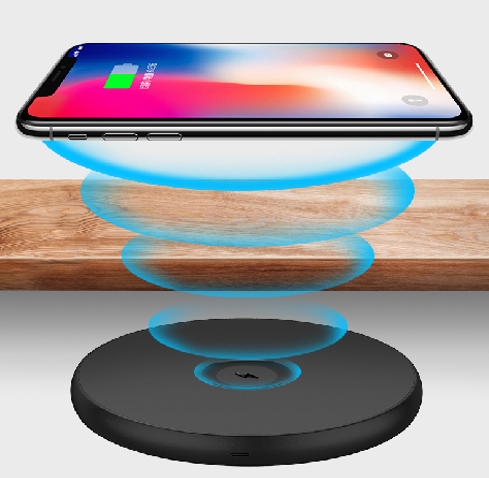
The distance between the transmitter and receiver also affects wireless power transfer.
As the distance increases, energy transfer generally becomes more difficult.
This becomes particularly important when wireless charging has to work through materials such as:
- Phone cases
- Furniture surfaces
- Protective covers
- Decorative materials
A small increase in distance may not seem significant to a user.
From an engineering perspective, however, it can change the coupling between the coils.
This is why wireless charging systems designed for greater distances require careful optimization of coil design, operating frequency, power control, and thermal performance.
Why Does the Phone Sometimes Get Hotter Than the Charger?
The heat isn’t necessarily generated in only one location.
There can be several sources of heat throughout the system.
For example:
Charging pad → Power electronics → Transmitter coil → Magnetic field → Receiver coil → Power management circuit → Battery
Losses can occur at multiple stages.
The transmitter electronics may generate heat.
The coil may have resistive losses.
The receiver coil may also generate heat.
Power management components inside the phone can generate additional heat.
The battery itself can warm up during charging.
So when you feel heat on the back of your phone, it doesn’t necessarily mean the wireless charger itself is inefficient.
The entire charging system needs to be considered.
The Coil Is More Important Than It Looks
The wireless charging coil is one of the key components in the system.
Its size, shape, number of turns, material, resistance, and surrounding structure can all influence performance.
Engineers need to balance several factors.
A coil should provide effective energy transfer while maintaining reasonable resistance and thermal performance.
It also needs to fit within the physical space available in the product.
This creates an interesting engineering challenge:
The coil needs to transfer more energy without becoming a major source of loss and heat.
As wireless charging becomes faster, this challenge becomes increasingly important.
Higher Charging Power Can Mean More Heat
This is a basic but important relationship.
If a wireless charging system transfers more power, the amount of energy being processed increases.
Even if efficiency remains relatively high, the absolute amount of energy lost as heat can increase.
For example, imagine two systems operating at the same efficiency.
A lower-power system may lose only a small amount of energy as heat.
A higher-power system can lose more energy simply because more total energy is being transferred.
That’s one reason fast wireless charging requires more careful thermal management.
Higher power isn’t just about increasing output.
The entire system has to handle the additional electrical and thermal load.
What About the Phone Case?
A phone case can also influence wireless charging performance.
A thin, compatible case may have little noticeable effect.
But thicker materials, certain metal components, magnetic accessories, or poorly positioned elements can interfere with energy transfer.
When the coupling between the coils becomes less efficient, more energy may be lost during the charging process.
Some accessories can also create additional heating concerns.
This is why wireless charging compatibility isn’t determined only by whether the phone physically fits on the charging pad.
The materials between the transmitter and receiver matter too.
Heat Isn’t Always Bad
It’s important not to misunderstand the role of heat.
Warm doesn’t automatically mean unsafe.
Electronic devices are designed to operate within certain temperature ranges.
Wireless charging systems can also monitor and manage temperature.
If temperatures rise beyond an acceptable level, the system may reduce charging power or stop charging temporarily.
This is an example of thermal management working as intended.
The objective isn’t necessarily to eliminate all heat.
That’s practically impossible.
The goal is to control heat and keep the system operating within appropriate limits.
How Engineers Reduce Wireless Charging Heat
Reducing heat starts with improving overall efficiency.
Engineers may optimize:
Coil Design
Better coil geometry and materials can improve energy transfer and reduce resistive losses.
Alignment
Keeping transmitter and receiver coils properly aligned can improve coupling.
Power Electronics
Efficient switching components and control circuits can reduce conversion losses.
Thermal Design
Heat needs a path to move away from components that generate it.
Charging Control
The system can dynamically adjust charging power based on temperature, battery conditions, and charging status.
These improvements work together.
There isn’t one component that magically makes a wireless charger cool.
Charging Doesn’t Stay at Maximum Power Forever
Another reason wireless charging can feel different at different times is that charging power is dynamic.
A phone may accept higher power when the battery is relatively low.
As the battery approaches a higher state of charge, charging power can gradually decrease.
Temperature can also affect the charging rate.
If the system becomes too warm, it may reduce power to control temperature.
This means charging performance isn’t necessarily constant from beginning to end.
The system continuously balances:
Speed + Efficiency + Temperature + Battery Conditions
That’s why modern wireless charging is much more sophisticated than simply turning power on and off.
Why Good Wireless Charger Design Matters
Two wireless chargers may have the same advertised power rating but perform differently in actual use.
The difference can come from:
- Coil design
- Component quality
- PCB layout
- Power conversion efficiency
- Thermal management
- Foreign object detection
- Charging control
- Manufacturing consistency
A good wireless charger isn’t simply one that can deliver high power.
It should deliver that power efficiently, consistently, and safely.
This becomes even more important for applications where wireless charging is integrated into furniture, vehicles, commercial equipment, or other products.
In those situations, thermal management and long-term reliability become critical parts of the overall design.
Wireless Charging Is Getting More Efficient
Wireless charging technology continues to evolve.
Higher power levels, better coil structures, improved power electronics, smarter charging algorithms, and better thermal management are helping improve the overall experience.
The goal isn’t simply to make wireless charging faster.
It’s to make it:
Faster.
More efficient.
More reliable.
More thermally controlled.
As wireless charging becomes integrated into more products and environments, these engineering improvements will become increasingly important.
Final Thoughts
So, why does wireless charging generate heat?
Because wireless energy transfer isn’t perfectly efficient.
Some energy is lost during power conversion, electromagnetic coupling, electrical resistance, and other processes—and much of that lost energy eventually becomes heat.
The good news is that heat can be managed.
Through better coil design, improved alignment, efficient power electronics, thermal management, and intelligent charging control, engineers can reduce unnecessary energy loss and keep temperatures within appropriate limits.
Wireless charging doesn’t need to be completely cool to be efficient. It needs to be well controlled.

About Honghao Electronics
At Honghao Electronics, we focus on the engineering details behind reliable wireless charging solutions.
From wireless charging modules and PCBA to coil design, power management, SMT assembly, and product testing, we help customers develop charging solutions for different applications and installation environments.
Whether wireless charging is integrated into a consumer product, piece of furniture, smart home device, or commercial application, efficient power transfer and thermal management are essential to long-term performance.
Better wireless charging isn’t just about sending more power.
It’s about transferring energy more efficiently.