
What Does “Off” Really Mean?
You press the power button.
The screen goes black.
The lights disappear.
The device looks completely inactive.
So naturally, you assume it has stopped using electricity.
But in many electronic products, that’s not exactly what happens.
A television can still respond to a remote.
A laptop can wake when you open the lid.
A smart speaker can wait for a command.
A charger can remain plugged into the wall without doing much—but still consume a small amount of power.
The device may look “off,” but some parts of the electronics can still be active.
So what is actually happening?


The Difference Between Off and Standby
The key concept is standby power.
When an electronic product enters standby mode, most of its functions are shut down or reduced.
But certain circuits remain powered.
Why?
Because the device needs a way to detect when you want it to wake up.
Imagine a television with absolutely no power going to any internal circuit.
How would it know that you pressed the remote control?
It couldn’t.
Something needs to remain active enough to receive the signal and trigger the rest of the system.
That small amount of electricity is what makes features like instant wake-up possible.
Not Every Part of the Device Stays On
This doesn’t mean the entire device continues operating normally.
Quite the opposite.
Modern electronics are designed to shut down as many unnecessary circuits as possible when they aren’t needed.
A typical system might divide its electronics into different power domains.
Some circuits may be completely disconnected from power.
Others may enter a low-power state.
A small control circuit may remain active.
For example:
Main processor → Sleep
Display → Off
Wireless functions → Low power
Memory → Low power
Power management controller → Active
This allows the device to consume far less energy while still being able to wake up when necessary.
The Tiny Circuit That Keeps Waiting
One of the most interesting parts of standby operation is the small amount of electronics that remains active.
This circuit might monitor:
- A power button
- A remote-control signal
- A USB connection
- A sensor
- A network signal
- A timer
- A charging condition
It doesn’t need to perform complicated calculations all the time.
It simply waits.
Think of it like a security guard sitting quietly at a door.
Most of the building can be dark.
But the guard still needs enough energy to stay awake.
That’s essentially what some low-power circuits are doing inside electronic products.
Why Does a Laptop Wake Up So Quickly?
Modern computers provide a good example.
When a laptop enters sleep mode, the operating system doesn’t necessarily shut everything down completely.
Instead, it reduces power consumption by placing various hardware components into low-power states.
Some memory and system-control functions may remain available so the computer can resume quickly.
That’s why opening the lid can bring the laptop back to life in seconds.
The system didn’t necessarily start from zero.
It was waiting.
This is one of the trade-offs engineers constantly manage:
Lower power consumption vs. faster wake-up.
Your Phone Does Something Similar
Smartphones are even more interesting.
When the screen is off, the phone isn’t necessarily inactive.
Depending on its configuration and operating state, various systems may continue performing background tasks.
For example:
- Maintaining network connectivity
- Receiving notifications
- Monitoring sensors
- Managing battery conditions
- Keeping time
- Waiting for user input
But the phone doesn’t run everything at full power.
Modern processors can enter extremely low-power states and wake only when needed.
This is one of the reasons a smartphone can remain available for hours while using relatively little power with the screen turned off.
Why Don’t Manufacturers Just Turn Everything Off?
Because completely shutting everything down would make many modern features impossible or inconvenient.
Imagine having to fully boot your phone every time you wanted to check the time.
Or having your smart speaker unable to hear a wake word until you physically turned it on.
Or having your television ignore the remote while “off.”
Users expect electronics to be ready.
That expectation creates an engineering challenge:
How do you keep a device responsive while using as little energy as possible?
The answer is power management.
Power Management Is Working in the Background
Power management circuits determine how electrical energy is distributed throughout an electronic product.
They can control which components receive power and when.
A system might have several different operating states:
Active → Sleep → Standby → Wake-up
Each state can use a different amount of energy.
When the user is actively using the device, more components operate.
When the device becomes idle, unnecessary systems are gradually reduced.
When the user returns, the system wakes the required components.
This dynamic control is one of the foundations of modern low-power electronics.
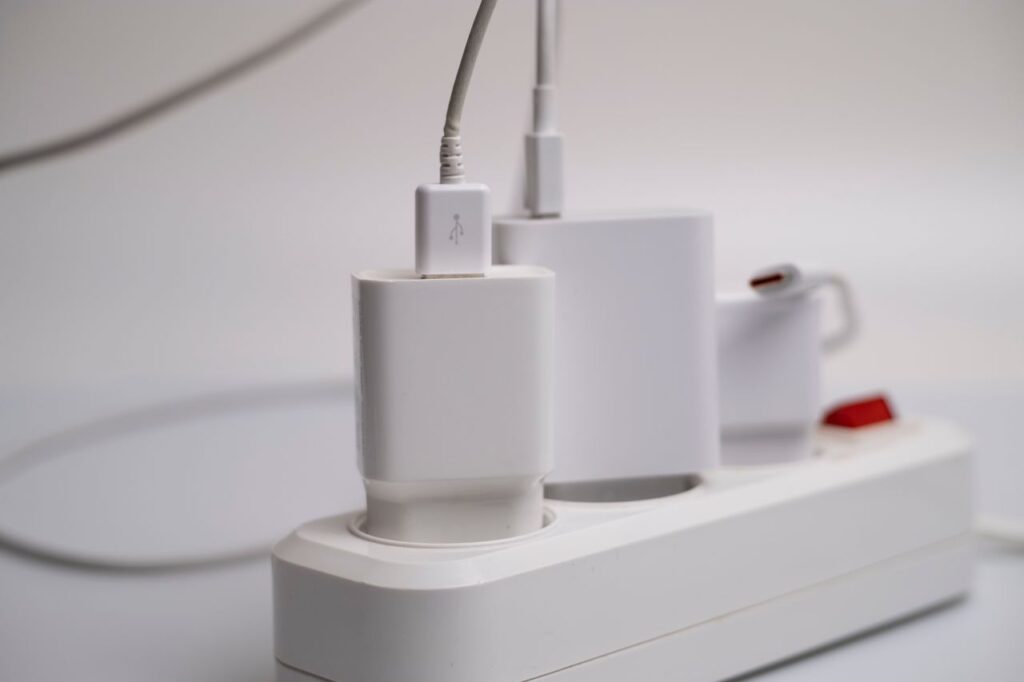
What About a Charger That’s Plugged In?
Here’s another familiar example.
You unplug your phone from a charger but leave the charger connected to the wall.
The charger isn’t charging your phone.
But is it completely inactive?
Not necessarily.
Modern chargers can still consume a small amount of standby power because some internal circuits remain connected to the input.
These circuits may monitor the input, maintain control functions, or remain ready for the next charging event.
Good charger design aims to minimize this standby consumption.
This is especially important because chargers may remain plugged in for long periods.
Small Power, Long Time
Standby power is usually much smaller than the power consumed when a device is operating.
But there is an interesting consideration:
Time.
A device might only consume a small amount of standby power at any given moment.
But if it remains connected to power for months or years, that small amount can accumulate.
This is why energy-efficiency standards and low-power design have become increasingly important.
Engineers don’t only look at how much power a device uses while operating.
They also consider what happens when it is doing almost nothing.
Smart Power Management Isn’t Just About Saving Energy
Reducing power consumption has another benefit:
Less heat.
Electrical energy that isn’t used efficiently can contribute to heat generation.
Lower-power operation can therefore help reduce unnecessary thermal load.
This matters particularly in compact electronics, where there may be very little physical space for heat dissipation.
A phone, smart device, wireless charger, or compact control board may have many components packed into a small area.
Every unnecessary watt can make thermal management more difficult.
The Challenge Gets Harder as Electronics Get Smaller
Modern electronics continue to become smaller.
At the same time, they are expected to do more.
More sensors.
More connectivity.
More processing.
More intelligent functions.
This makes power management increasingly important.
Engineers have to decide:
Which circuits need to stay awake?
Which can sleep?
How quickly should they wake up?
How much energy can they consume?
What happens if the device remains idle for hours or days?
These decisions may not be visible from the outside.
But they can have a major effect on battery life, heat, reliability, and user experience.
The Engineering Behind “Instant”
Users often expect electronics to respond immediately.
Press a button.
Open a laptop.
Place a phone on a charger.
Say a wake word.
The device responds.
That feeling of immediacy doesn’t happen by accident.
Behind it are carefully designed power states, control circuits, firmware, sensors, and power-management systems.
Engineers are constantly balancing two competing goals:
Use as little energy as possible.
Be ready as quickly as possible.
The better that balance is designed, the more “natural” the product feels.
So, Are Your Electronics Really Off?
Sometimes, yes.
Some devices can completely disconnect their internal electronics from the power source.
Others enter a low-power or standby state instead.
It depends on the product, its design, its operating system, and what functions it needs to maintain.
So the statement “your electronics are never really off” isn’t literally true for every device.
But it captures an interesting reality:
Many modern electronics don’t simply switch between ON and OFF.
They operate across multiple power states.
And most of those states are invisible to the user.
Final Thoughts
The next time you turn off a device, remember that “off” doesn’t always mean the same thing electrically.
Some systems shut down almost completely.
Others enter standby.
Some tiny circuits remain active, waiting for a button press, signal, sensor event, or charging connection.
That quiet background activity is the result of careful power management.
It allows modern electronics to be responsive without constantly consuming the energy required for full operation.
And that’s one of the fascinating things about electronic engineering:
Sometimes the smartest part of a product is the part that knows when to stop working.
About Honghao Electronics

At Honghao Electronics, we focus on the power management and electronic engineering details that make modern products more efficient and reliable.
From PCBA and SMT assembly to wireless charging, power management, product testing, and manufacturing, we help customers develop electronic solutions designed for real-world applications.
Because good electronics aren’t only about what happens when a product is working.
They’re also about knowing when it doesn’t need to.