
Why Not Just Use More Power?
Imagine your phone suddenly becomes slow.
Why not simply give the processor more power?
Or your wireless charger isn’t charging fast enough.
Why not just increase the output?
It sounds logical.
More power should mean more performance.
But electronics don’t work quite that way.
Every electronic device has limits.
More power can mean more heat, higher electrical stress, greater energy consumption, and shorter component life.
In many cases, the problem isn’t whether a device can use more power.
It’s whether the entire system can handle it.
That’s why modern electronics constantly adjust how much power they use.

Power Isn’t Free
Electrical power eventually has to go somewhere.
Some of it becomes useful output.
Some of it becomes heat.
Some is lost during electrical conversion.
For a simple electronic circuit, the relationship can be expressed as:
Power = Voltage × Current
If you increase current or voltage, power consumption can increase.
And when more electrical energy is processed, the system often has to deal with additional heat.
This is one of the fundamental challenges of electronics:
More power doesn’t automatically mean more useful performance.
Heat Is One of the Biggest Limits
Almost every electronic component produces some heat during operation.
Processors generate heat.
Power ICs generate heat.
Voltage regulators generate heat.
Wireless charging coils can generate heat.
Even PCB traces and connectors can experience losses.
As power increases, thermal management becomes more difficult.
A device can only remove heat at a certain rate.
If it generates heat faster than it can dissipate it, temperature will continue to rise.
And that’s where problems begin.
What Happens When Electronics Get Too Hot?
High temperatures can affect electronic components in several ways.
Performance may decrease.
Protection systems may activate.
Components can experience greater electrical stress.
Battery charging may slow down.
Long-term reliability can also be affected.
This is why many electronic devices automatically reduce their power when temperatures become too high.
Your phone may reduce processor performance.
A laptop may increase fan speed.
A charger may reduce charging power.
A wireless charging system may lower its output.
It isn’t necessarily a failure.
The system is protecting itself.
Your Phone Does This All the Time
Your smartphone is a good example.
When you’re simply reading an article, the processor doesn’t need to operate at maximum performance.
Running everything at full power would waste energy and create unnecessary heat.
Instead, modern processors can dynamically adjust their operating conditions.
When you open a demanding application, more processing resources can become active.
When the workload decreases, the system can reduce power consumption.
This creates a simple principle:
Use more power when necessary. Use less when possible.
That balance helps improve battery life and thermal performance.
Why Doesn’t a Charger Always Deliver Maximum Power?
The same idea applies to charging.
Suppose a charger is capable of delivering high power.
That doesn’t mean the connected device will always request or accept that maximum output.
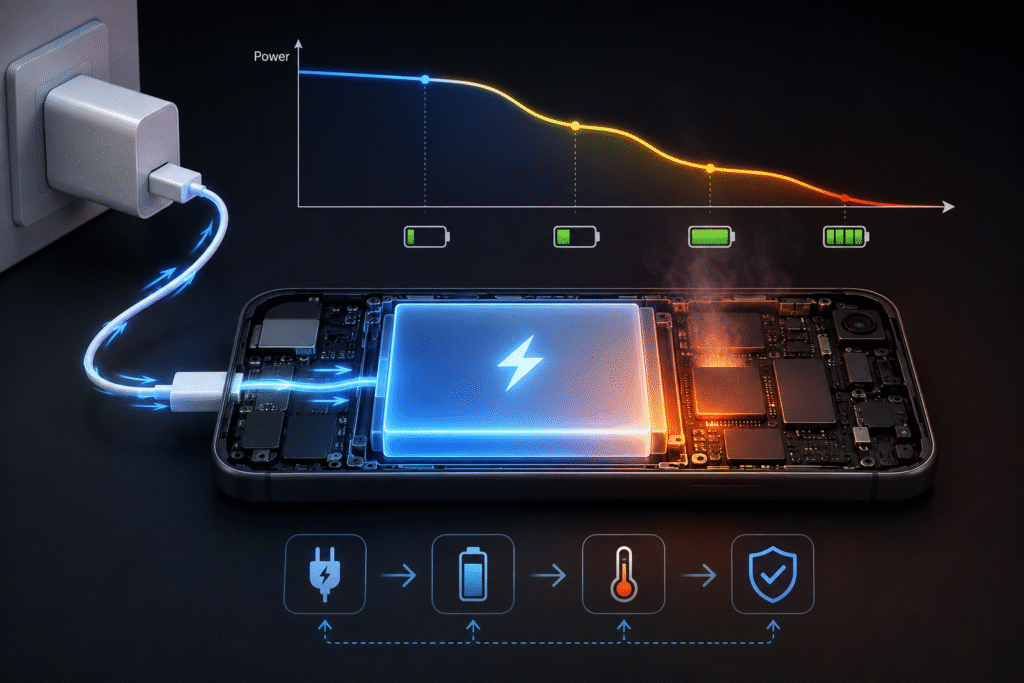
Charging is usually controlled through communication between the charger and the device.
The device determines how much power it can safely use based on factors such as:
- Battery condition
- Temperature
- Charging stage
- Device design
- Supported charging protocol
- Current system load
The charger may be capable of supplying more.
But the device doesn’t necessarily need it.
Maximum available power is not the same as required power.
Batteries Have Their Own Limits
Battery-powered electronics face another challenge.
A battery has limits on how quickly it can safely deliver or receive energy.
Higher current can increase internal losses and heat.
During charging, temperature and battery state can influence how much power the battery can accept.
That’s why charging usually isn’t a simple process of:
Plug in → Maximum Power → Full Battery
Instead, the charging system continuously adjusts power according to the battery’s condition.
This helps balance charging speed, temperature, battery health, and safety.
Efficiency Matters Too
Imagine an electronic system receives 100 watts of electrical power.
It doesn’t necessarily convert all 100 watts into useful output.
If the system is 90% efficient, roughly 90 watts become useful output while the remaining energy is lost, largely as heat.
At low power, that loss may be manageable.
At high power, the same percentage of loss can represent a much larger amount of heat.
This is why efficiency becomes increasingly important as power levels increase.
The higher the power, the more expensive inefficiency becomes.
Components Have Physical Limits
Electronic components aren’t infinitely capable.
Every component has specifications.
A capacitor has a voltage rating.
A resistor has a power rating.
A MOSFET has voltage and current limits.
A connector has a current capacity.
A PCB trace has limits on how much current it can safely carry.
Exceeding these limits can cause overheating, instability, degradation, or failure.
This is why engineers don’t simply increase power until something breaks.
They design the system around appropriate operating margins.
More Power Can Create More Stress
Higher electrical power can place greater stress on components.
For example, increasing current through a conductor increases resistive losses.
One common relationship is:
Power Loss = I²R
The important part here is the I².
If current doubles, resistive power loss can increase by four times, assuming resistance remains constant.
That’s one reason high-current electronics require careful PCB design, component selection, thermal management, and power distribution.
A small increase in current can sometimes create a surprisingly large increase in heat.
This Is Especially Important in Compact Electronics
Modern devices keep getting smaller.
But their performance requirements continue increasing.
That creates a difficult engineering problem.
There is less physical space for:
- Heat sinks
- Cooling systems
- Larger components
- Wider traces
- Additional power circuitry
At the same time, users expect faster processors, faster charging, brighter displays, and more powerful wireless functions.
Engineers therefore have to squeeze more performance out of limited physical space.
This is why power management has become such an important part of modern electronic design.
Power Management Is the Traffic Controller
You can think of a power management system as a traffic controller.
It decides where electrical energy should go, when it should be used, and how much is appropriate.
It can help:
- Regulate voltage
- Control current
- Reduce unnecessary consumption
- Manage charging
- Monitor temperature
- Protect components
- Switch circuits between power states
Without effective power management, an electronic product would have a much harder time balancing performance and reliability.
The goal isn’t to use the most power possible.
It’s to use the right amount of power at the right time.
Full Power Isn’t Always Full Performance
There’s another important point.
Running a component at maximum power doesn’t necessarily produce a proportional increase in performance.
A processor may reach thermal limits.
A power supply may become less efficient.
A battery may drain much faster.
A wireless charging system may generate significantly more heat.
At some point, additional power produces diminishing returns.
Good engineering therefore focuses on optimization, not simply maximum output.
The best system isn’t necessarily the most powerful one.
It’s the one that delivers the required performance efficiently and reliably.
Why Devices Reduce Power Automatically
This explains many things you may have noticed.
Why does your phone slow down when it gets very hot?
Why does charging become slower near full battery?
Why does a laptop fan suddenly become louder?
Why does a wireless charger sometimes reduce its charging speed?
Why does a device consume very little power when you’re not using it?
These behaviors are often connected to the same principle:
The system is continuously managing energy.
It monitors conditions and adjusts power accordingly.
Sometimes that means increasing power.
Sometimes it means reducing it.
Good Electronics Know When to Slow Down
A well-designed electronic product isn’t supposed to operate at maximum power all the time.
It needs to know when maximum performance is necessary—and when it isn’t.
It also needs to recognize when operating at full power could create excessive heat or electrical stress.
This is where sensors, control circuits, firmware, power ICs, and protection mechanisms work together.
The user may simply see a phone charging or a laptop running.
Behind the scenes, however, the system can be making hundreds or thousands of small power-management decisions.
The Real Goal Is Balance
Electronic engineering is full of trade-offs.
More power can mean more performance.
But it can also mean more heat.
More charging speed can mean shorter charging time.
But it can also increase thermal demands.
Smaller products save space.
But they can make heat dissipation harder.
Higher performance can improve the user experience.
But it can increase energy consumption.
The challenge is finding the right balance.
Performance. Efficiency. Temperature. Reliability. Cost.
All of these factors have to work together.
Final Thoughts
So, why can’t electronics just run at full power?
Because full power isn’t always necessary, efficient, or safe.
Every electronic system has limits.
Components have electrical ratings.
Batteries have charging and discharge limits.
Cooling systems have thermal limits.
Power supplies have efficiency limitations.
And users ultimately expect products to remain reliable—not simply powerful.
That’s why modern electronics constantly adjust their power consumption.
They speed up when they need to.
They slow down when they should.
They sleep when they’re idle.
And they reduce power when conditions become unfavorable.
The smartest electronic products aren’t the ones that use the most power.
They’re the ones that know exactly how much power they need.

About Honghao Electronics
At Honghao Electronics, we focus on the power and hardware engineering behind reliable electronic products.
From PCBA and SMT assembly to wireless charging, power management, circuit design, and product testing, we help develop electronic solutions that balance performance, efficiency, thermal management, and long-term reliability.
Because good engineering isn’t about pushing electronics to their limits.
It’s about knowing where those limits are—and designing intelligently around them.