
Wireless charging can look almost effortless.
Place a phone on a charging pad, and power starts flowing without a cable.
But what happens when you move the phone farther away?
At first, charging may continue normally.
Move it farther, and charging performance can decrease.
Move it even farther, and the device may no longer receive enough useful power.
So what exactly limits the range of wireless charging?
It isn’t just one thing.
Distance, coil design, alignment, power, materials, efficiency, and thermal management all play a role.
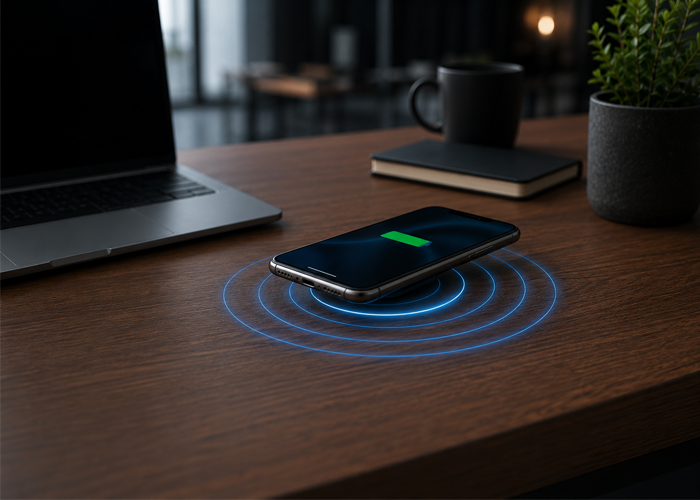
Wireless Power Depends on Coupling
Wireless charging generally uses electromagnetic coupling between a transmitting coil and a receiving coil.
The transmitter creates an alternating electromagnetic field.
The receiver captures energy from that field and converts it into usable electrical power.
When the two coils are close together and properly aligned, energy transfer can be relatively efficient.
As the distance increases, the coupling between the coils becomes weaker.
That means the system has to work harder to transfer the same useful amount of energy.
This is one of the fundamental reasons wireless charging has practical distance limits.
The farther apart the coils are, the harder it becomes to maintain efficient power transfer.
Distance Isn’t Just a Number
It’s tempting to describe wireless charging with a single distance:
10 mm.
20 mm.
30 mm.
50 mm.
But distance alone doesn’t tell the whole story.
A wireless charging system might technically transfer energy across a certain gap, but that doesn’t mean it can provide the same charging power at every distance.
For example, a system that works efficiently at 10 mm may require a different design to operate at 30 mm.
And a system designed for 50 mm may need to accept lower charging power or different performance requirements depending on the application.
That’s why engineers need to consider distance and power together.
Coil Design Makes a Big Difference
The transmitting and receiving coils are at the center of a wireless charging system.
Their size, shape, structure, and electrical characteristics can all affect power transfer.
A larger coil isn’t automatically better.
A higher-power transmitter isn’t automatically better either.
The transmitter and receiver need to be designed to work together.
The surrounding structure also matters.
For embedded wireless charging, the coil may need to operate underneath a desktop, panel, or other surface.
The available installation space can therefore influence the entire system design.
Wireless charging range begins with the relationship between the transmitter and receiver.
Alignment Matters
Distance isn’t the only challenge.
Position matters too.
Imagine the transmitter coil is directly underneath the receiving coil.
The system is in its intended position.
Now move the phone several centimeters to one side.
The coils may no longer be optimally aligned.
As alignment changes, coupling can decrease and charging performance may be affected.
This is particularly important for hidden wireless charging.
When the charging module is installed underneath a desk, the user may not be able to see its exact position.
A practical design therefore needs to consider not only how far the energy has to travel, but also how easily the user can position the device correctly.
The Material Between the Coils Matters
Wireless charging can work through many non-metallic materials.
This makes it useful for hidden and embedded applications.
A charging module can potentially be installed underneath materials such as wood, plastic, glass, or certain decorative surfaces.
But the material isn’t simply an invisible layer.
Its thickness and physical characteristics can affect the distance between the transmitter and receiver and therefore the overall system performance.
As the surface becomes thicker, the charging system effectively has to operate across a greater separation.
That’s why a design that works well through a thin panel may require additional optimization when the panel becomes much thicker.
Metal Can Create Additional Challenges
Metal is particularly important in wireless charging design.
A conductive metal structure near the electromagnetic field can introduce additional losses and may cause unwanted heating.
This means engineers need to understand the environment around the charging module.
For example, installing a wireless charging transmitter underneath a surface isn’t only about asking:
“How thick is the surface?”
It may also be necessary to ask:
“What is the surface made of, and what else is located around the charging module?”
The surrounding structure can become part of the wireless charging system.
Power Is One of the Biggest Limits
Suppose a wireless charging system can transfer energy across a relatively large distance.
Does that mean it can charge a phone quickly at that distance?
Not necessarily.
This is one of the most important differences between energy transfer and useful charging power.
A system may be able to transfer some energy across a larger gap.
But maintaining higher charging power at that distance is much more challenging.
As the required power increases, the transmitter, receiver, power electronics, and thermal system all have to handle greater demands.
So when engineers talk about wireless charging range, they also need to ask:
How much power needs to be delivered at that range?
Why 10–30 mm Can Be a Practical Range
For hidden and embedded charging applications, a moderate distance can provide a useful balance between installation flexibility and charging performance.
At Honghao Electronics, our long-distance wireless charging solutions typically cover 10–30 mm, depending on the application and required power.
This can allow the charging module to be installed underneath a desktop or other surface while keeping the charging hardware hidden from view.
The user simply places the phone above the designated charging area.
There is no visible charging pad sitting on the desk.
This is one of the practical advantages of longer-distance wireless charging.
What About 50 mm?
A 50 mm transmission distance can also be achievable with an appropriate system design.
However, this is where the relationship between distance and charging power becomes particularly important.
Going from 30 mm to 50 mm isn’t simply a matter of adding another 20 mm.
The system needs to maintain suitable energy transfer across the larger gap.
Depending on the application, achieving 50 mm may involve compromises in charging power, efficiency, thermal performance, or other system parameters.
So a technically achievable distance isn’t automatically the same thing as an ideal production solution.
The required charging power needs to be considered alongside the target distance.
Efficiency Becomes More Important as Distance Increases
Every wireless charging system has losses.
Energy can be lost during power conversion, electromagnetic transfer, and other parts of the system.
When the charging distance increases, maintaining good efficiency becomes more challenging.
And inefficiency has another consequence:
Heat.
Energy that doesn’t become useful output can contribute to thermal losses.
Higher heat can then affect components, charging performance, and long-term reliability.
This creates a chain of engineering considerations:
Greater distance → More challenging energy transfer → Efficiency considerations → Thermal considerations
That’s why extending wireless charging range isn’t simply about increasing transmitter power.
Thermal Management Still Matters
Higher transmission power can create additional heat in the transmitter and receiver.
For an embedded charging system, this can be especially important because the charging module may be installed inside a relatively confined space.
Engineers need to consider how heat is generated and how it can be dissipated.
The system therefore has to balance:
- Charging distance
- Output power
- Efficiency
- Temperature
- Component ratings
- Installation environment
A system that transfers power successfully but generates excessive heat may not be suitable for a real product.
There’s No Universal Maximum Distance
So, what is the maximum range of wireless charging?
There isn’t one universal number.
A better answer is:
It depends on what you want the system to achieve.
A low-power device may work across a greater distance than a device requiring higher charging power.
A large transmitter and receiver may allow a different design than a compact consumer product.
A hidden installation under a thin desktop is different from a much thicker surface.
And a system designed for simple energy transfer has different requirements from one designed for practical battery charging.
The range is therefore a design parameter, not a single fixed specification.
Designing for the Right Distance
When developing a wireless charging solution, engineers should start with the application rather than the maximum possible range.
Important questions include:
How much charging power is required?
How thick is the surface?
What material is between the coils?
How much space is available for the transmitter?
How accurately will users position the device?
What temperature limits need to be maintained?
Once these requirements are clear, the wireless charging system can be designed around a realistic operating range.
That approach is usually much more useful than simply trying to make the charging distance as large as possible.
Final Thoughts
So, what limits the range of wireless charging?
The answer isn’t simply distance.
The practical range is influenced by coil design, electromagnetic coupling, alignment, surface materials, charging power, efficiency, and thermal management.
A wireless charging system may be capable of transferring energy across a certain distance, but the real engineering challenge is maintaining enough useful power and stable performance at that distance.
For many hidden charging applications, 10–30 mm provides a practical working range.
Greater distances, including 50 mm, can be achievable with suitable system design, but charging power and overall efficiency need to be considered carefully.
In the end, the goal isn’t to make wireless charging reach as far as possible.
It’s to make it work reliably at the distance the product actually needs.
About Honghao Electronics
At Honghao Electronics, we develop wireless charging solutions for embedded and hidden-installation applications.
Our long-distance wireless charging solutions typically support 10–30 mm installation distances, while customized designs can reach 50 mm when the application requirements allow, with charging power and efficiency carefully considered.
From wireless charging development and PCBA to SMT assembly, testing, and mass production, we help customers develop practical solutions around their specific installation distance, power requirements, and product structure.
Because successful wireless charging isn’t just about reaching farther.
It’s about finding the right balance between distance, power, efficiency, and reliability.