
Wireless Charging Without Touching
Most people think of wireless charging like this:
Place your phone directly on the charging pad.
Charging starts.
Simple.
But what if the phone doesn’t need to touch the charger?
What if there is a desk, panel, or other material between the charging module and the device?
This is where long-distance wireless charging becomes interesting.
Wireless power transfer doesn’t necessarily require direct contact.
The real question is:
How far can it actually work?
The answer isn’t simply a number.
It depends on the charging system, coil design, alignment, materials, operating frequency, and—most importantly—the power you want to deliver.
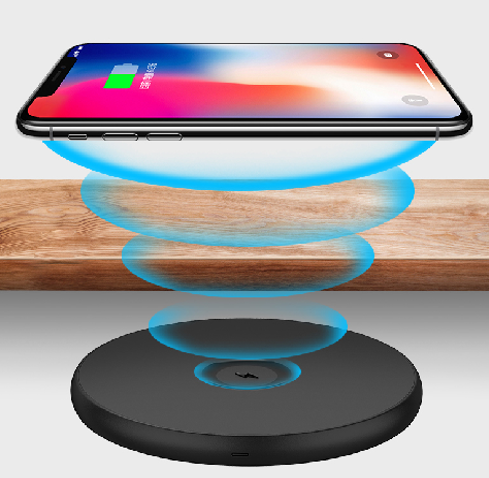
Wireless Charging Works Through an Electromagnetic Field
Wireless charging transfers energy through electromagnetic coupling between a transmitting coil and a receiving coil.
The transmitter generates an alternating electromagnetic field.
A receiving coil positioned within that field can capture part of the energy and convert it back into electrical power.
This is the basic principle behind many wireless charging systems.
The important word here is coupling.
The transmitter and receiver need to interact effectively.
As the distance increases, maintaining that effective coupling becomes more difficult.
And that’s where the engineering challenge begins.
Distance Makes Wireless Charging Harder
Imagine two coils positioned very close together.
Their electromagnetic fields interact strongly.
Now move the receiving coil farther away.
The interaction becomes weaker.
As the distance increases, it becomes more difficult to transfer the same amount of energy efficiently.
This doesn’t mean wireless charging suddenly stops working at a particular distance.
Instead, performance gradually becomes more challenging.
Engineers may need to optimize:
- Coil size
- Coil structure
- Operating frequency
- Transmitter power
- Receiver design
- Alignment
- Magnetic materials
- Thermal management
- Control algorithms
So the question isn’t simply:
“Can wireless charging work at 30 mm?”
It’s:
“Can it deliver the required power efficiently and reliably at 30 mm?”
That’s a much more useful question.
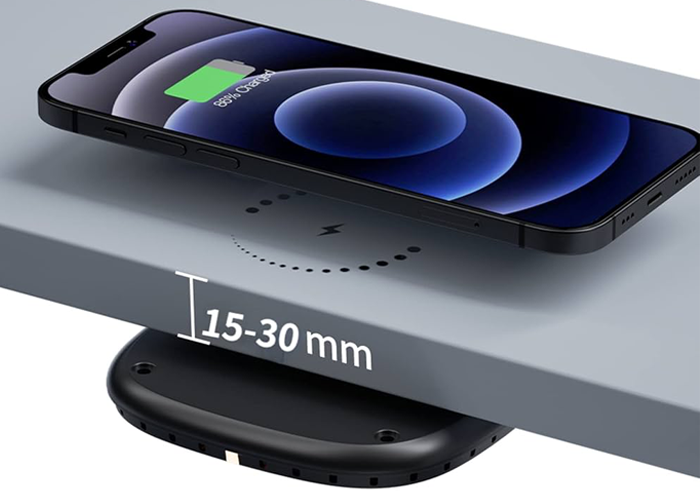
10 mm, 20 mm, 30 mm—Why Does It Matter?
For applications such as hidden or embedded wireless charging, the distance between the charging module and the device can be important.
A charging module may need to be installed underneath a desktop surface, countertop, panel, or other material.
The user sees a clean surface.
The charging hardware remains hidden underneath.
In these situations, even a few millimeters can make a significant difference to the system design.
At Honghao Electronics, our long-distance wireless charging solutions commonly cover approximately 10–30 mm, depending on the application and required charging performance.
This range can support applications where the charging module needs to be hidden beneath a surface rather than placed directly against the device.
Can Wireless Charging Reach 50 mm?
Yes, 50 mm can be technically achievable in a suitable system design.
But there’s an important qualification.
Greater distance doesn’t come for free.
As the transmission distance increases, maintaining useful charging power becomes more difficult.
A system may be able to transfer some energy across a larger gap, but that doesn’t automatically mean it can provide the same charging power as a system operating at a shorter distance.
This is an important distinction.
Wireless charging distance and wireless charging power are closely connected.
A 50 mm system may be possible for a particular application, but the required power level, efficiency, coil configuration, installation structure, and thermal conditions all need to be considered.
More Distance Doesn’t Always Mean Better
It’s tempting to think:
10 mm → 20 mm → 30 mm → 50 mm → 100 mm
and assume that longer is always better.
But that’s not how product design works.
If increasing the distance results in significantly lower charging power or efficiency, the extra distance may not provide much practical value.
For example, imagine two solutions.
One can charge efficiently at 20 mm.
Another can technically transfer power at 50 mm but delivers considerably less useful output.
Which one is better?
It depends on the application.
If the product only needs low power, the 50 mm solution may be perfectly reasonable.
If the product needs faster charging, the shorter-distance solution may be more practical.
The best wireless charging distance is the one that matches the application’s actual requirements.
Alignment Matters Too
Distance isn’t the only factor.
Alignment between the transmitter and receiver is also important.
The transmitting coil and receiving coil are designed to work together.
If the receiver moves away from the optimal position, coupling can decrease.
This can affect charging efficiency and power transfer.
That’s why wireless charging systems often use carefully designed coil structures and control systems to maintain stable operation.
For hidden charging applications, this becomes particularly important.
The user may not be able to see where the charging coil is located underneath the surface.
The product therefore needs to provide a practical charging area while maintaining reliable energy transfer.
What Is Between the Coils Also Matters
Wireless charging doesn’t necessarily mean the coils need to be exposed.
Depending on the system design, energy can be transferred through certain non-metallic materials.
This makes wireless charging attractive for embedded applications.
A charging module can be installed beneath:
- Wood
- Plastic
- Glass
- Composite panels
- Certain stone or decorative surfaces
However, material thickness and characteristics still matter.
As the distance between the transmitter and receiver increases, the system has less room for inefficiency.
The surface material, thickness, coil placement, and surrounding components all become part of the engineering problem.
Metal Can Be a Different Story
Metal requires particular attention.
A nearby conductive metal structure can interact with the electromagnetic field and potentially cause additional losses or heating.
That’s why wireless charging systems designed for installation beneath surfaces need to consider the materials surrounding the charging module.
The question isn’t simply:
“Can the signal pass through this material?”
Engineers also need to consider how that material interacts with the electromagnetic field.
This is one reason a real product application often requires more than simply choosing a powerful wireless charging transmitter.
Power Is the Real Challenge
Let’s come back to the most important point.
Distance isn’t the only target. Power matters.
Imagine a wireless charging system that can transfer energy over 50 mm.
That sounds impressive.
But if the system only provides a small amount of usable power at that distance, it may not be suitable for a device that needs faster charging.
Increasing transmission distance while maintaining useful power requires careful engineering.
The system needs to balance:
Distance + Power + Efficiency + Heat + Stability
Improving one parameter can affect the others.
That’s why long-distance wireless charging is fundamentally a system-design problem.
Why Doesn't Everyone Just Use 50 mm?
Because different products need different things.
A retail counter may prioritize installation flexibility.
A desk may prioritize hidden installation.
A smart home product may prioritize appearance.
A consumer device may prioritize charging speed.
An industrial product may prioritize stability and reliability.
These applications don’t necessarily need the same charging distance.
For some products, 10 mm may be enough.
For others, 20–30 mm can provide a useful installation distance.
A specialized application may justify 50 mm if the required charging power is compatible with the system.
There is no universal “best” wireless charging distance.
Longer Distance Requires More Than a Bigger Coil
It’s easy to assume that increasing the transmitter size or power will solve everything.
In reality, long-distance wireless power transfer involves multiple engineering factors.
The coil needs to be designed appropriately.
The transmitter needs to generate a suitable electromagnetic field.
The receiver needs to capture that energy efficiently.
The power electronics need to convert it correctly.
The control system needs to manage the transfer.
And the whole system needs to stay within reasonable thermal and electrical limits.
This is why long-distance wireless charging is not simply a matter of “turning up the power.”
Efficiency Becomes More Important
When wireless charging operates over a short distance, energy transfer can be relatively straightforward.
As the distance increases, efficiency becomes increasingly important.
Why?
Because any energy that doesn’t reach the receiver doesn’t simply disappear.
It can contribute to losses and heat within the system.
If a product is designed to deliver useful charging power, engineers need to pay attention to where the energy goes throughout the entire system.
That includes:
Input power → Transmitter → Wireless transfer → Receiver → Power conversion → Battery
Every stage matters.
The Best Design Is Application-Specific
This is perhaps the most important lesson.
When designing a wireless charging system, engineers shouldn’t start with:
“How far can we make it work?”
A better starting point is:
“What does the product actually need?”
How thick is the surface?
How much power does the device require?
How much space is available for the charging module?
How accurately does the user need to position the device?
What materials are around the system?
What temperature limits need to be maintained?
Once those questions are answered, the appropriate wireless charging architecture becomes much easier to determine.
Final Thoughts
So, how far can wireless charging really work?
There isn’t one universal answer.
Wireless charging can operate across different distances depending on the system design.
For hidden and embedded applications, 10–30 mm can provide a practical range for many use cases.
With specialized design, 50 mm can also be achievable, but the required charging power and overall system efficiency need to be considered carefully.
That’s because increasing distance isn’t simply about making the wireless field “reach farther.”
It’s about maintaining useful power, reasonable efficiency, stable operation, and acceptable heat at that distance.
In wireless charging, farther isn’t automatically better.
The real goal is to find the right distance for the power the product actually needs.


About Honghao Electronics
At Honghao Electronics, we develop wireless charging solutions for applications where traditional charging interfaces aren’t always practical or desirable.
Our solutions include embedded and long-distance wireless charging, with typical installation distances of around 10–30 mm, while customized designs can reach greater distances, including 50 mm, depending on the required charging power and application conditions.
From wireless charging module development and PCBA to SMT assembly, testing, and mass production, we work with customers to find the right balance between installation distance, charging power, efficiency, and reliability.
Because long-distance wireless charging isn’t simply about going farther.
It’s about going far enough—while still delivering the power the product needs.