
In the early days of wireless charging, the market was flooded with low-cost “charging pads” that often sacrificed safety for price. Today, as we move into 2026, the demand has shifted. From high-end office furniture to hospitality and industrial integration, the world now requires invisible, high-efficiency, and thermally stable power solutions.
At Honghao Electronics, we have spent years bridging the gap between raw PCB assembly and finished consumer electronics. This article explores the technical challenges of modern wireless power—specifically Long-Distance (30mm) induction and Multi-functional Integration—and the manufacturing rigors required to bring these products to the global market.
Chapter 1: The Core of Wireless Power – Understanding the PCBA
The Printed Circuit Board Assembly (PCBA) is the brain of any wireless charger. While a trading company might see a board as a commodity, we see it as a complex ecosystem of power management.
1.1 Component Selection: Beyond the Datasheet
At Honghao, our engineering team prioritizes component longevity.
NPO Capacitors: Unlike cheaper MLCCs, NPO capacitors maintain stability across a wide temperature range, ensuring the resonance frequency doesn’t drift during a 2-hour charging cycle.
Low RDS(on) MOSFETs: We select transistors with minimal internal resistance to reduce heat dissipation—the primary enemy of wireless charging efficiency.
1.2 Thermal Management via PCB Layout
Heat is not just a safety issue; it’s an efficiency killer. Our PCB designs utilize:
Thermal Vias: Strategically placed copper-lined holes that pull heat away from the MCU to the bottom layer.
Heavy Copper Traces: 2oz copper thickness (standard is often 1oz) to handle high-current induction without overheating the substrate.
Chapter 2: Solving the 30mm Gap – The Physics of Long-Distance Induction
Standard Qi charging operates at 3-8mm. Moving to 30mm (Long-Distance) introduces exponential magnetic decay.
2.1 The Challenge of Magnetic Flux Leakage
As the distance increases, the magnetic field spreads out. To solve this without “over-powering” the circuit (which causes interference), we employ:
High-Q Induction Coils: Custom-wound multi-strand oxygen-free copper litz wires. These reduce the “Skin Effect” and maximize the Quality Factor (Q).
Ferrite Shielding Optimization: We don’t just use a standard ferrite disk. We customize the permeability (μ) of the magnetic shield to focus the flux toward the receiver, preventing energy from leaking into the surrounding furniture or electronics.
2.2 Adaptive Frequency Tuning
Furniture materials—be it oak, marble, or glass—have different dielectric constants. A “static” charger will fail or overheat. Our firmware uses an Auto-Tuning Loop that senses the impedance of the environment and adjusts the switching frequency in real-time to maintain peak resonance.
Chapter 3: Multi-Functional Integration – Managing Interference
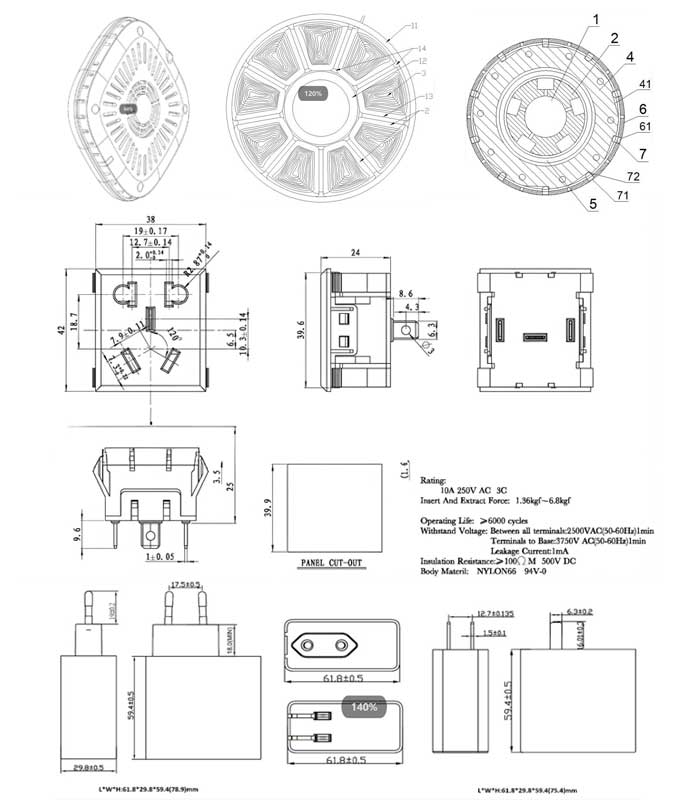
Our Multi-function Wireless Charging Sockets combine high-voltage AC (110V-240V) with sensitive DC wireless circuits. This is an EMI (Electromagnetic Interference) nightmare if handled poorly.
3.1 EMI Isolation Techniques
To prevent the “hum” or interference with office Wi-Fi and laptops, Honghao engineers implement:
Physical Isolation Barriers: Internal shielding compartments that separate the AC power strip logic from the wireless charging PCBA.
Advanced Filtering: Common-mode chokes and X/Y capacitors to suppress noise from the switching power supply.
Chapter 4: Manufacturing Excellence – The Honghao Production Floor
“Factory Direct” is a promise of accountability. Our facility in China follows a strict “Zero-Defect” trajectory.
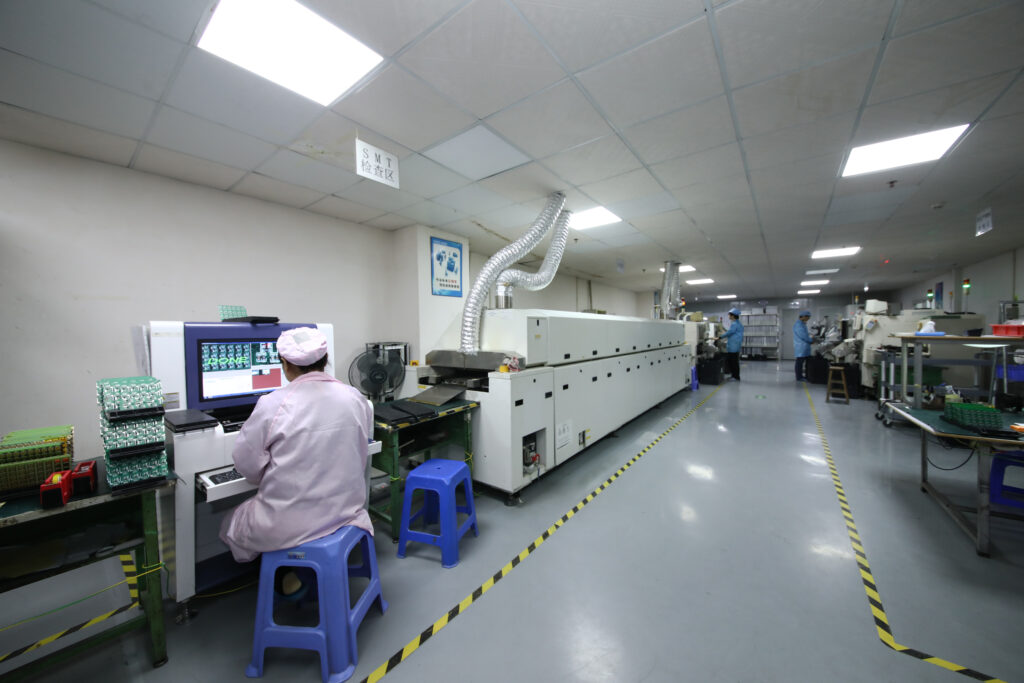
4.1 SMT (Surface Mount Technology) Precision
With components like 0201 resistors becoming common, human hands cannot ensure quality. Our high-speed SMT lines utilize Solder Paste Inspection (SPI) and Automated Optical Inspection (AOI) to verify every solder joint before the board ever reaches assembly.
4.2 The Reality of Aging Tests
We do not believe in “spot-checking.”
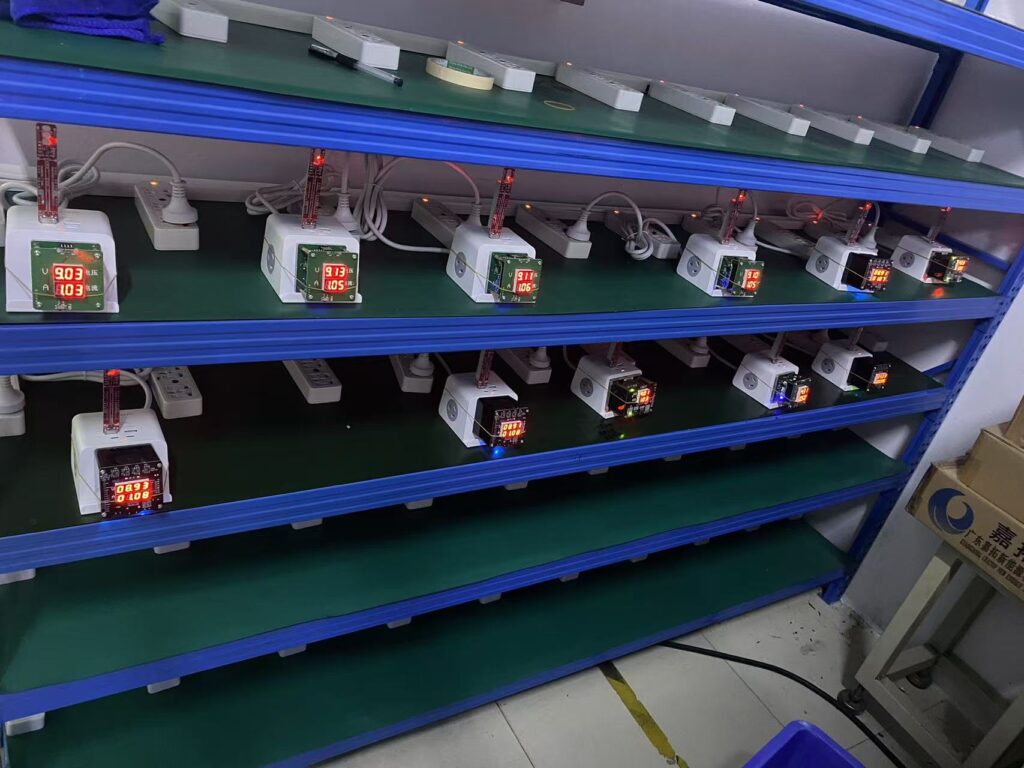
4-Hour Full-Load Burn-in: Every batch of PCBA undergoes a continuous 4-hour charge/discharge cycle. If a component is going to fail, we want it to fail in our factory, not in your customer’s office.
Chapter 5: Global Compliance – Safety as a Standard
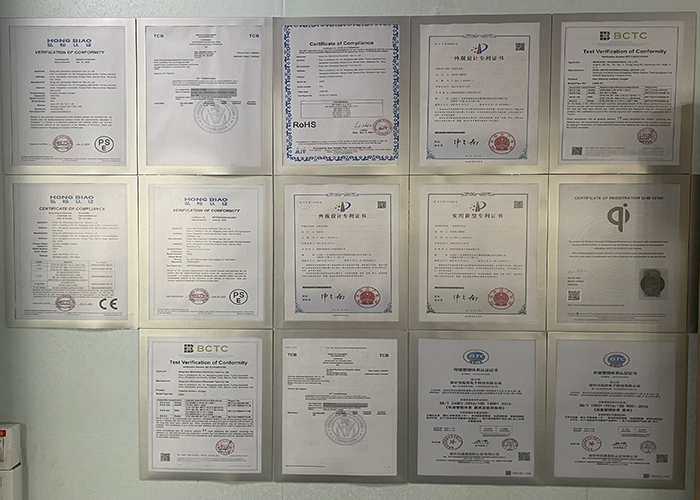
Exporting to the US, Europe, and Southeast Asia requires more than just a logo.
FOD (Foreign Object Detection): This is where we spend the most time in firmware. If a customer accidentally leaves a coin or a foil gum wrapper on a 30mm charger, the system must detect the “Parasitic Power Loss” and shut down within milliseconds.
Certifications: Our products are designed with CE, FCC, and RoHS standards in mind from the first day of prototyping, not as an afterthought.
Chapter 6: Why Partnership Matters (The Marketing Edge)
When you work with Honghao Electronics, you aren’t just buying a SKU; you are accessing an engineering resource.
Direct Engineering Communication: No “lost in translation” with middlemen.
Customization Flexibility: Whether you need a specific PCBA shape to fit into a lamp or a custom wattage for industrial tablets, our in-house design team can iterate prototypes in days, not months.
Conclusion: Engineering the Future of Power
Wireless power is no longer a gimmick; it is an essential infrastructure. At Honghao Electronics, we remain committed to the “unsexy” but vital parts of the business: thermal stability, firmware reliability, and manufacturing precision.
We don’t promise magic; we deliver solid, factory-tested engineering.