
In the modern digital age, our smartphones and laptops are extensions of ourselves. We rely on them for work, connection, and navigation. Naturally, the “Low Battery” notification triggers a Pavlovian response: we scramble for the nearest cable.
But have you ever noticed your phone getting alarmingly hot while charging? Or perhaps, after six months of using a “bargain” charger, your battery health has plummeted from 100% to 85%?
At Honghao Electronics, we’ve spent years under the hood of charging technology. As a premier manufacturer specializing in PCBA (Printed Circuit Board Assembly) and advanced wireless power solutions, we’ve seen exactly what happens when power management goes wrong. The truth is: Not all chargers are created equal.
Here are the three critical things you need to check before you plug in, and the hidden science that protects your tech.
1. The “Brain” Test: Is the PCBA Smart Enough?
Most users look at the plastic shell of a charger. At Honghao, we look at the PCBA. The PCBA is the “brain” of your charger. Its job is to convert high-voltage AC from your wall into steady, safe DC for your battery.
Why it matters to your battery:
A low-quality PCBA lacks the precision components needed to filter “ripple current.” Imagine trying to fill a water balloon with a fire hose—if the pressure isn’t perfectly regulated, something is going to burst. Cheap circuit boards often skip Over-Voltage Protection (OVP) and Under-Voltage Protection (UVP) to save costs.
The Honghao Edge:
Our PCBA manufacturing process involves rigorous SMT (Surface Mount Technology) precision and multi-stage testing. We integrate smart ICs (Integrated Circuits) that communicate with your device. When your phone reaches 80%, our boards tell the charger to “trickle charge,” reducing stress on the lithium-ion cells. We don’t just assemble boards; we engineer thermal management directly into the copper layers.
2. The “Invisible” Efficiency: Distance vs. Heat in Wireless Charging
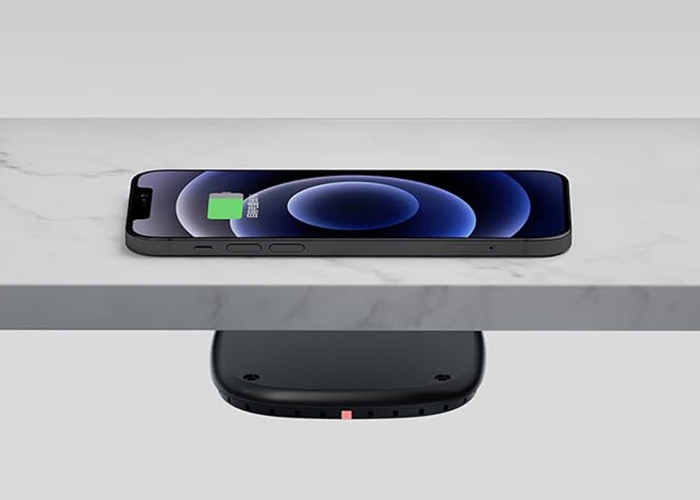
Wireless charging is a lifestyle game-changer, especially Under-Desk (Long-distance) Wireless Chargers. But “magic” comes with a technical challenge: Heat.
The Science of the “Sweet Spot”:
Standard wireless chargers require your phone to be perfectly aligned. If it’s off-center, the induction coils struggle, generating wasted energy as heat. Heat is the #1 killer of battery longevity.
The Honghao Solution:
We’ve mastered the art of Magnetic Resonance. Our under-desk chargers are designed to penetrate 10mm–30mm of wood or glass with maximum efficiency. By optimizing the coil density and the PCBA’s frequency switching, we ensure that the energy goes into your battery, not into heating up your desk. It’s the difference between a “hot plate” and a “smart charger.”
.png)
3. Versatility vs. Overload: The Multi-Functional Balance
We all love Multi-functional Wireless Charging Sockets because they declutter our desks. However, plugging in a laptop, a lamp, and two phones simultaneously puts a massive load on the internal circuitry.
What to check:
Does your power strip have Load Balancing? Without it, the charger might pull too much current, leading to a short circuit or, in extreme cases, a fire hazard.
How we build it:
At Honghao, our multi-functional units are built with industrial-grade fire-retardant materials and high-spec PCBAs that handle multi-channel power distribution. Whether it’s our Portable Power Banks or our integrated desk sockets, we prioritize Electromagnetic Compatibility (EMC). This ensures that your wireless charger won’t interfere with your Wi-Fi signal or your laptop’s performance.
4. Portable Power: Power Banks & Conversion Rates
A Power Bank is only as good as its conversion efficiency.
The Conversion Gap: Many 10,000mAh banks only deliver 6,000mAh. Why? Poor PCBA efficiency.
Honghao’s Standard: By optimizing the boost-converter circuits on our boards, we achieve 85-90% efficiency, giving users more actual charge and less “phantom” drain.
5. Global Standards: The Safety “Must-Haves”
Before you source or buy, you must look for international compliance. These aren’t just logos; they are technical barriers.
CE & FCC: For electromagnetic safety.
RoHS: Ensuring no hazardous materials (like lead) are in the solder of the PCBA.
Over-Charge Protection: Ensuring the charger “sleeps” when your device is full.
Why Honghao Electronics? (The Manufacturer’s Perspective)
Choosing a charging partner isn’t just about buying a product; it’s about sourcing a reliable heartbeat for your electronics.
Integrated Production: Because we handle everything from PCBA processing to final assembly, we have total control over the quality gate.
Global Standards: Our products are engineered to meet international safety certifications (CE, FCC, RoHS), ensuring they are safe for homes and offices worldwide.
Innovation-Driven: From invisible under-desk power to high-density power banks, we stay ahead of the curve so our clients don’t have to worry about the “tech debt” of outdated hardware.
Final Thoughts: Protect Your Investment
Your smartphone cost you $1,000. Why risk it with a $5 charger? Next time you shop for power solutions—whether you’re a business looking for a reliable PCBA partner or a consumer upgrading your workspace—look past the plastic. Ask about the board, check the thermal specs, and choose a brand that understands the science of power.
Ready to upgrade your power experience? Explore Honghao Electronics’ latest collection of Under-Desk Wireless Chargers and Smart Power Solutions. [Click here to Contact our engineering team for PCBA OEM/ODM inquiries].