
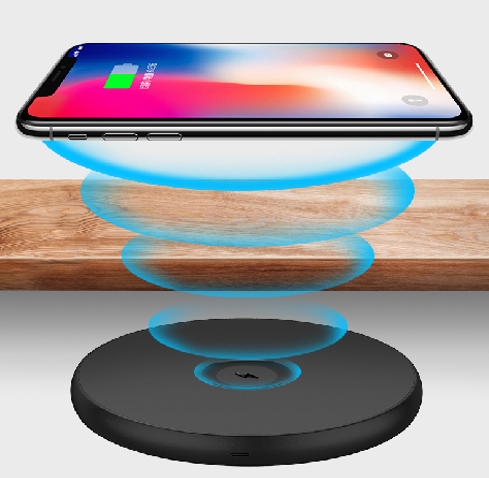
Imagine placing your phone on a clean wooden desk with no visible charging pad, no cable, and no connector in sight — yet the battery icon immediately starts moving.
For many people, the first reaction is confusion.
Where is the charger? How does power travel through the desk? Is it safe? Does it work reliably? And perhaps most importantly: is this technology actually practical, or is it just another futuristic gimmick?
The answer is surprisingly simple.
This is not magic.
It is the result of years of engineering development in embedded wireless power transmission, material compatibility optimization, thermal management, coil design, and intelligent power control.
Wireless charging has already become common in smartphones, earbuds, and wearable devices. But today, the industry is moving beyond visible charging pads toward something more integrated: invisible charging built directly into furniture, counters, hotel rooms, vehicles, conference tables, and public infrastructure.
At Honghao Electronics, we have spent years focusing on practical wireless charging integration technologies, including:
- 3–12mm embedded wireless charging solutions
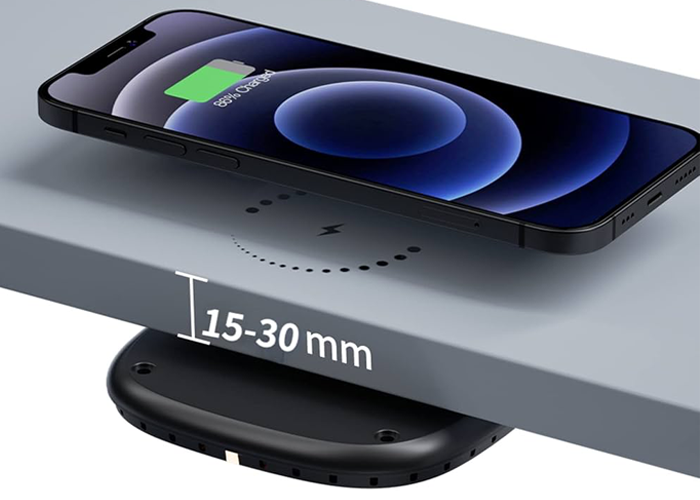
- 10–28mm long-distance wireless charging systems
- 10–30mm remote wireless charging solutions
- OEM and customized wireless charging modules
- Integrated charging solutions for furniture and commercial products
Rather than treating wireless charging as a novelty feature, we approach it as an engineering problem that must balance efficiency, safety, reliability, manufacturability, and user experience.
This article explores how hidden wireless charging actually works, why the technology is becoming increasingly important across industries, what technical challenges manufacturers face, and how practical engineering determines whether a wireless charging product succeeds or fails in real-world environments.
The Shift From Visible Chargers to Invisible Power
For decades, charging electronics meant dealing with cables.
Users accepted tangled wires, damaged connectors, and limited placement freedom because there were few alternatives.
The first wave of wireless charging improved convenience by eliminating direct cable connections, but most systems still relied on visible charging pads.
These pads solved one problem while introducing another.
They occupied desk space. They disrupted furniture aesthetics. They often slid around during use. And in commercial spaces such as hotels or offices, they created cleaning and durability issues.
As product designers and furniture manufacturers began prioritizing minimalist design, a new requirement emerged:
Can charging disappear completely from view?
This question drove the development of embedded wireless charging.
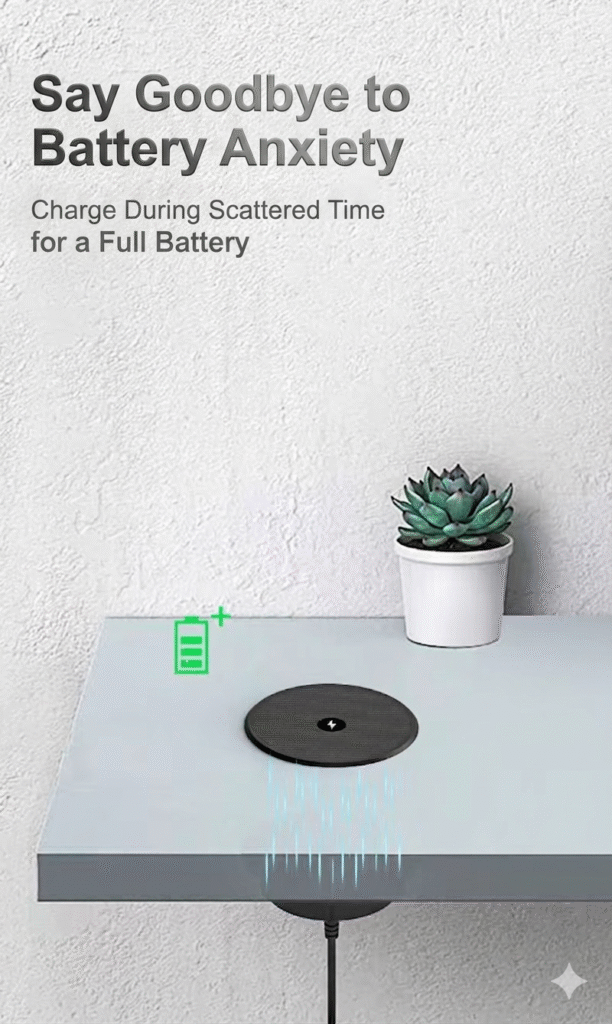
Instead of placing a charging pad on top of a surface, engineers integrate the charging module underneath the material itself.
The result is a cleaner, more seamless user experience:
- Place the phone naturally on the desk
- No visible charging accessory
- No exposed cable clutter
- No installation complexity for users
- Better aesthetics for commercial environments
From the user perspective, it feels almost invisible.
But from the engineering perspective, making wireless charging work through wood, plastic, marble substitutes, glass, or composite materials is significantly more difficult than standard surface charging.
That is where technical experience becomes critical.
How Embedded Wireless Charging Actually Works
Wireless charging is based primarily on electromagnetic induction.
In simplified terms:
- The transmitter coil generates an alternating electromagnetic field.
- The receiver coil inside the phone detects this field.
- Energy transfers wirelessly between the coils.
- The phone converts the received energy into battery charging power.
At first glance, the concept sounds straightforward.
In practice, however, efficient wireless charging depends on multiple variables working together precisely.
These include:
- Coil alignment
- Coil diameter
- Transmission frequency
- Power management
- Thermal performance
- Material thickness
- Material density
- Foreign object detection
- Electromagnetic interference control
- Charging protocol compatibility
When charging through a desk or table surface, additional complexity appears because the transmission distance increases.
A normal visible charging pad may operate with almost direct contact between transmitter and receiver.
But embedded charging systems may need to transmit power through:
- 3mm wood
- 5mm acrylic
- 8mm laminate
- 10mm composite surfaces
- 12mm furniture panels
- Even greater distances in advanced long-range applications
Every extra millimeter affects efficiency, heat generation, stability, and alignment tolerance.
This is why embedded charging is not simply “putting a charger under the table.”
It requires system-level engineering optimization.
Why Thickness Matters in Wireless Charging
One of the most misunderstood aspects of embedded wireless charging is transmission distance.
Many people assume wireless charging either works or does not work.
In reality, performance changes continuously as distance increases.
As the gap between transmitter and receiver grows:
- Energy transfer efficiency decreases
- Heat generation can increase
- Charging speed may drop
- Alignment becomes more sensitive
- Power loss becomes more significant
- Foreign object detection becomes more challenging
This is why high-quality embedded charging solutions require careful optimization for specific thickness ranges.
At Honghao Electronics, our embedded wireless charging systems are designed for practical integration scenarios such as:
3–12mm Embedded Wireless Charging
This range is ideal for:
- Office desks
- Wooden tables
- Nightstands
- Hotel furniture
- Reception counters
- Retail displays
- Smart home furniture
The challenge here is maintaining stable charging performance while preserving furniture aesthetics and installation flexibility.
Different materials behave differently.
For example:
- Solid wood has varying densities
- MDF panels may contain adhesives affecting electromagnetic performance
- Metal layers can interfere with transmission
- Stone surfaces may create thermal challenges
- Laminates affect signal behavior differently depending on composition
An experienced wireless charging manufacturer must evaluate these variables carefully.
The Rise of Long-Distance Wireless Charging
As industries demand more flexible charging experiences, standard embedded charging is no longer enough for every application.
Some manufacturers now require charging systems capable of operating over larger gaps.
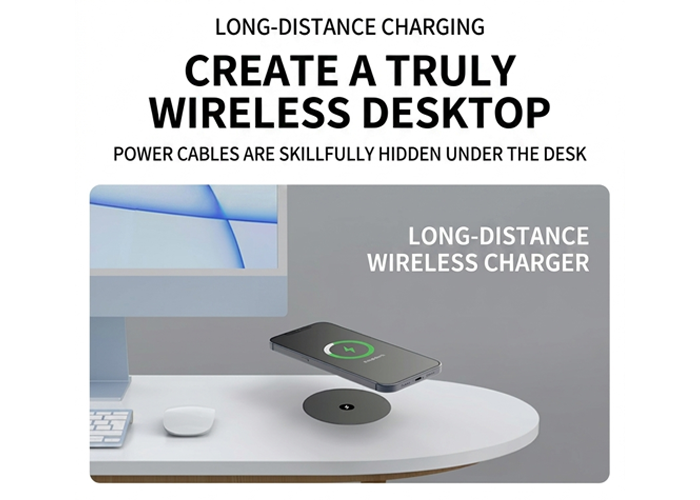
This demand has accelerated the development of long-distance wireless charging technologies.
At Honghao Electronics, we develop:
- 10–28mm long-distance wireless charging systems
- 10–30mm remote wireless charging solutions
These technologies enable charging across thicker materials or larger structural gaps.
Potential applications include:
- Thick conference tables
- Industrial equipment
- Specialized medical equipment
- Smart retail systems
- Vehicle interior integration
- Public infrastructure
- Hidden charging inside cabinets
- Protective enclosure charging
However, longer distance charging creates additional engineering challenges.
The farther energy travels wirelessly, the more important these factors become:
- Coil structure optimization
- Magnetic field control
- Thermal balancing
- Power efficiency management
- Intelligent communication between transmitter and receiver
- Safety protection mechanisms
This is why practical long-distance wireless charging is still heavily dependent on engineering capability rather than marketing claims.
Real-world performance matters more than theoretical specifications.
Why Real Engineering Matters More Than Marketing
The wireless charging industry contains many exaggerated claims.
Some products advertise unrealistic charging distances or theoretical power levels that perform poorly in real environments.
In actual commercial deployment, customers care about different questions:
- Does charging start reliably?
- Will the system overheat?
- Can it work continuously?
- Does it interfere with nearby electronics?
- Is the installation stable?
- Can it pass safety testing?
- Will it still work after years of daily use?
- Is it compatible with mainstream smartphones?
These practical concerns are where engineering experience becomes more valuable than marketing language.
At Honghao Electronics, our focus is not on presenting wireless charging as futuristic science fiction.
Instead, we focus on solving practical integration challenges for manufacturers, furniture companies, commercial projects, and OEM customers.
In many cases, success depends less on achieving maximum theoretical power and more on achieving consistent, reliable operation under real conditions.
For example:
A hotel installing wireless charging into bedside furniture does not want guests struggling to find the charging area.
An office furniture manufacturer does not want overheating issues inside wooden desks.
A retail environment needs charging modules capable of long operational cycles.
An OEM customer may require customized dimensions, power specifications, or installation methods.
These are engineering and manufacturing problems — not just technology demonstrations.
Thermal Management: The Hidden Challenge
One of the biggest technical challenges in wireless charging is heat.
Whenever energy transfers wirelessly, some energy loss becomes heat.
If thermal management is poor, several problems may occur:
- Reduced charging efficiency
- Slower charging speeds
- User discomfort
- Component aging
- Reduced product lifespan
- Safety concerns
- Charging interruptions
Heat becomes even more important in embedded charging because the transmitter may be enclosed inside furniture or structural materials.
Unlike exposed charging pads, embedded systems have more limited airflow.
This means thermal design cannot be treated as an afterthought.
Effective thermal management may involve:
- Coil optimization
- Power regulation algorithms
- Intelligent temperature monitoring
- Material selection
- Structural heat dissipation design
- Charging power balancing
At Honghao Electronics, thermal stability is one of the key considerations during product development because stable long-term operation matters more than short-term demonstration performance.
Compatibility Is More Complicated Than Most People Think
Consumers often assume all wireless charging systems work identically.
In reality, compatibility can vary significantly.
Different smartphones may have:
- Different receiver coil positions
- Different charging protocols
- Different power requirements
- Different thermal protection systems
- Different alignment tolerances
Even two phones with the same advertised wireless charging capability may behave differently on the same embedded charging surface.
For manufacturers integrating wireless charging into products, this creates important testing requirements.
Reliable suppliers must validate performance across multiple devices and operating conditions.
This includes testing:
- Charging initiation consistency
- Position tolerance
- Heat generation
- Charging interruption behavior
- Material interference
- Foreign object detection
- Power stability
Compatibility testing is especially important in public or commercial environments where users may place many different devices on the charging surface.
Safety Is Not Optional
As wireless charging becomes more integrated into furniture and infrastructure, safety requirements become increasingly important.
Professional wireless charging systems must consider:
- Overcurrent protection
- Overvoltage protection
- Overtemperature protection
- Foreign object detection
- Electromagnetic compliance
- Power regulation stability
- Short-circuit protection
For example, if metal objects such as coins or keys are placed between the charger and device, improper system design may create overheating risks.
Advanced foreign object detection systems help prevent unsafe operation.
Similarly, charging systems integrated into furniture must account for long operating hours and changing environmental conditions.
At Honghao Electronics, practical safety design is treated as a core engineering requirement rather than a secondary feature.
Especially in OEM manufacturing environments, long-term stability and compliance are essential.
Why Furniture Manufacturers Are Adopting Embedded Charging
Furniture is no longer just furniture.
Modern commercial and residential spaces increasingly integrate technology directly into the environment.
This trend is especially visible in:
- Smart offices
- Hotels
- Luxury apartments
- Co-working spaces
- Cafes
- Conference rooms
- Retail environments
- Educational facilities
Consumers now expect convenient charging access almost everywhere.
But visible chargers create several design problems:
- Cable clutter
- Surface disruption
- Maintenance complexity
- Cleaning inconvenience
- Lower visual consistency
Embedded charging solves these issues while supporting minimalist product design.
For furniture manufacturers, hidden charging also creates product differentiation without dramatically changing user behavior.
Users simply place their devices naturally on the surface.
This simplicity is important.
The most successful technologies often feel invisible.
Commercial Applications Beyond Furniture
While desks and tables are common use cases, embedded wireless charging now extends far beyond furniture.
Industries exploring wireless charging integration include:
Hospitality
Hotels increasingly integrate hidden charging into:
- Bedside tables
- Lobby furniture
- Lounge areas
- Business centers
This improves guest convenience while reducing visible cable clutter.
Automotive
Vehicle manufacturers continue exploring wireless charging integration into:
- Center consoles
- Armrests
- Rear seating areas
- Smart interior systems
Future automotive integration may rely more heavily on longer-distance charging solutions.
Retail
Retail stores use charging integration for:
- Interactive displays
- Customer waiting areas
- Smart product displays
- Experience-focused retail environments
Healthcare
Medical environments value wireless charging because it can reduce exposed connectors and simplify equipment handling.
Industrial Equipment
Wireless charging can reduce wear on mechanical connectors in environments with vibration, moisture, or repeated handling.
These applications often require highly customized engineering solutions.
Conclusion
When a phone begins charging through a desk with no visible charger, it can feel almost magical.
But behind that experience lies a significant amount of engineering:
- Electromagnetic design
- Coil optimization
- Thermal control
- Material compatibility testing
- Power management
- Safety systems
- Manufacturing consistency
- Real-world application experience
Embedded wireless charging is no longer just an experimental concept.
It is becoming a practical technology used across furniture, hospitality, offices, retail environments, and industrial products.
As the industry evolves, the focus is shifting away from visible charging accessories toward seamless environmental integration.
At Honghao Electronics, we continue focusing on practical wireless charging solutions designed for real applications — including 3–12mm embedded wireless charging, 10–28mm long-distance wireless charging, and 10–30mm remote wireless charging technologies.
Our goal is not simply to make wireless charging possible.
It is to help manufacturers and commercial customers integrate wireless power in ways that are stable, reliable, and genuinely useful in everyday environments.
Because in the end, the best technology often feels invisible.
And when your desk quietly charges your phone without cables or visible hardware, it may look like magic.
But it is actually the result of careful engineering, practical experience, and years of continuous technical development.
Looking for embedded or long-distance wireless charging solutions for your products or projects?
Honghao Electronics provides practical wireless charging technologies for furniture integration, commercial applications, OEM projects, and customized product development. Whether you need 3–12mm embedded charging, 10–28mm long-distance charging, or customized wireless power solutions, our engineering team can help evaluate the right approach for your application.