
In today’s rapidly evolving electronics landscape, the expectation for convenience, efficiency, and seamless user experience continues to grow. One of the most intriguing developments meeting these expectations is wireless charging—especially technologies that eliminate not only cables but even physical contact.
But this raises a fundamental question:
How can devices be charged without cables or contact?
At first glance, it may sound like science fiction. However, behind this innovation lies a combination of advanced electromagnetic theory, precision circuit design, and high-reliability manufacturing processes.
In this article, we will explore:
- The core principles behind contactless and distance wireless charging
- The engineering challenges that determine product success or failure
- The critical role of PCBA design and SMT manufacturing
- How Honghao Electronics delivers scalable, high-performance wireless charging solutions
1. Understanding Wireless Power Transfer
Wireless charging is not a single technology—it is a spectrum of solutions based on different physical principles and application requirements.
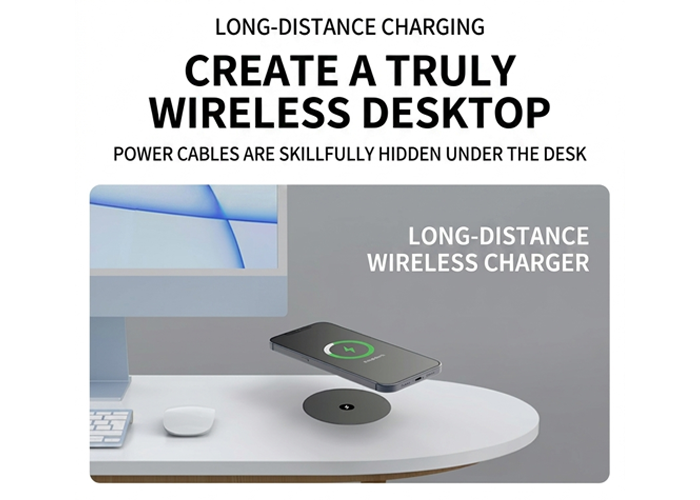
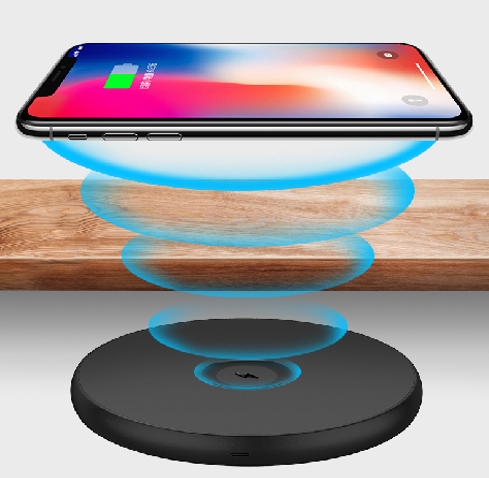
1.1 Near-Field Wireless Charging (Embedded Solutions: 3–12 mm)
The most widely used form today is inductive coupling, where energy is transferred between two coils through a magnetic field.
- Operating distance: typically 3–12 mm
- Common applications: smartphones, wearables, medical devices, industrial handhelds
- Advantages: high efficiency, mature ecosystem, stable performance
In embedded applications, such as furniture-integrated chargers or sealed industrial equipment, precise alignment and coil design are essential.
1.2 Mid-Range Wireless Charging (10–28 mm)
As product design evolves, there is increasing demand for greater spatial freedom.
Mid-range wireless charging extends the usable distance while maintaining acceptable efficiency. This requires:
- Advanced coil structures
- Higher power control precision
- Improved thermal management
This range is particularly suitable for:
- Smart home products
- Automotive interiors
- IoT devices
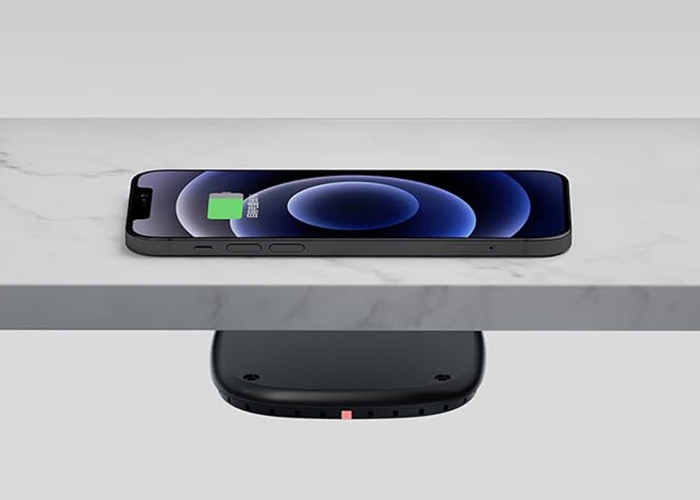
1.3 Extended Distance Wireless Charging (10–30 mm)
At longer distances, the challenges grow exponentially.
Maintaining stable energy transfer across 10–30 mm gaps requires:
- Highly optimized electromagnetic field distribution
- Sophisticated power management algorithms
- Tight tolerance control in PCB and assembly
This is where many solutions fail—not due to concept limitations, but due to engineering and manufacturing gaps.
2. Why Wireless Charging Projects Fail
Despite the apparent simplicity of “no cable charging,” the reality is far more complex.
2.1 Unstable Power Transfer
Many designs struggle with:
- Fluctuating output power
- Sensitivity to alignment
- Interference from surrounding materials
2.2 Thermal Issues
Poor PCBA design can lead to:
- Excessive heat buildup
- Reduced efficiency
- Shortened product lifespan
2.3 Inconsistent Manufacturing Quality
Even a well-designed system can fail if:
- SMT precision is insufficient
- Component placement varies
- Soldering quality is inconsistent
2.4 Lack of System-Level Integration
Wireless charging is not just a coil—it is a complete system, including:
- Power control ICs
- Protection circuits
- Firmware optimization
- Mechanical integration
3. The Critical Role of PCBA in Wireless Charging
At the heart of every wireless charging solution is the PCBA (Printed Circuit Board Assembly).
3.1 High-Frequency Circuit Design
Wireless charging operates at high frequencies, requiring: Controlled impedance Minimal signal loss Optimized trace routing Even small layout errors can lead to significant efficiency loss.
3.2 Power Management Optimization
Efficient wireless charging depends on: Dynamic power adjustment Foreign object detection (FOD) Over-voltage and over-current protection These must be precisely implemented at the PCB level.
3.3 Thermal Design
Heat dissipation must be carefully engineered through: Copper thickness optimization Thermal vias Component placement strategy

4. SMT Manufacturing: Where Design Meets Reality
Even the best design cannot succeed without high-precision SMT (Surface Mount Technology).
4.1 Component Placement Accuracy
Wireless charging circuits require:
- Tight tolerances
- Consistent positioning of critical components
- High repeatability across batches
4.2 Soldering Quality
Reliable performance depends on:
- Uniform solder joints
- Minimal defects
- Strong mechanical and electrical connections
4.3 Process Control
Advanced SMT lines ensure:
- Automated inspection (AOI)
- Real-time quality monitoring
- High yield rates
5. From Concept to Mass Production: A System Approach
Successful wireless charging products require a holistic approach:
- Concept validation
- Electromagnetic simulation
- PCBA design and prototyping
- SMT process optimization
- Reliability testing
- Mass production scaling
Any weak link in this chain can compromise the entire product.
6. Honghao Electronics: Powering Wireless Innovation
At Honghao Electronics, we specialize in delivering end-to-end wireless charging solutions, combining deep engineering expertise with advanced manufacturing capabilities.
6.1 Our Wireless Charging Capabilities
We provide:
- 3–12 mm Embedded Wireless Charging Solutions
Ideal for compact, integrated designs requiring high efficiency and stability - 10–28 mm Mid-Range Wireless Charging Solutions
Designed for enhanced flexibility in consumer and industrial applications - 10–30 mm Extended Distance Wireless Charging Solutions
Engineered for challenging environments where distance and reliability are critical
6.2 Advanced PCBA Expertise
Our engineering team focuses on:
- High-frequency PCB design
- Power optimization
- EMI/EMC compliance
- Thermal management
6.3 High-Precision SMT Manufacturing
Our production lines are equipped with:
- State-of-the-art SMT machines
- Automated optical inspection (AOI)
- Strict quality control systems
This ensures:
- Consistent product performance
- High reliability
- Scalable mass production
6.4 Industry Experience
With years of experience in:
- Consumer electronics
- Smart home devices
- Industrial applications
We understand the real-world challenges of bringing wireless charging products to market.
7. Applications of Contactless Wireless Charging
Wireless charging is transforming multiple industries:
7.1 Consumer Electronics
- Smartphones
- Earbuds
- Wearables
7.2 Smart Home
- Smart lighting
- IoT devices
- Kitchen appliances
7.3 Automotive
- In-car charging systems
- Sensor power supply
7.4 Industrial & Medical
- Sealed equipment
- Harsh environment devices
- Hygienic, contact-free systems
8. Future Trends in Wireless Charging
The future of wireless power is moving toward:
- Greater charging distance
- Higher efficiency
- Multi-device charging
- Integration with smart systems
Companies that master both design and manufacturing will lead this transformation.
9. Conclusion
So, how can devices be charged without cables or contact?
The answer lies in a sophisticated combination of:
- Electromagnetic engineering
- Precision PCBA design
- High-quality SMT manufacturing
- System-level optimization
Wireless charging is no longer just a convenience—it is becoming a core technology shaping the future of electronics.
At Honghao Electronics, we are committed to helping our partners turn innovative ideas into reliable, scalable products.
10. Partner With Us
If you are developing wireless charging products and need:
- Reliable PCBA design
- High-quality SMT manufacturing
- Proven wireless power solutions
Honghao Electronics is your trusted partner.
Contact us today to discuss how we can support your next project.