
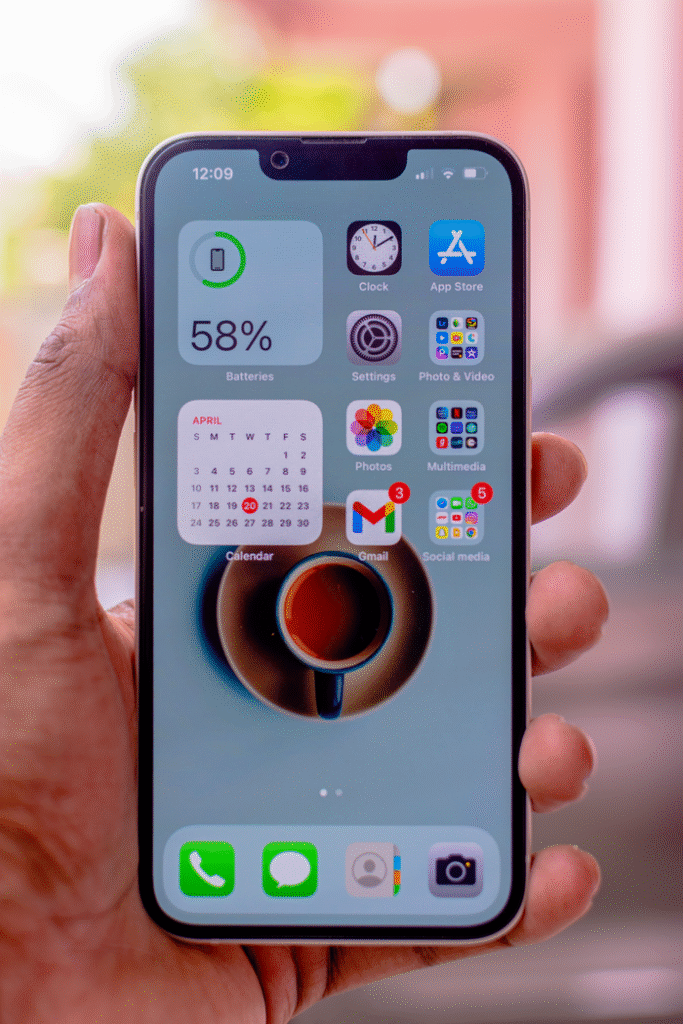
Look at the top corner of your phone.
58%.
You probably don’t think twice about it.
You see 87%, you know you have plenty of battery left. At 20%, you start looking for a charger. At 5%, you suddenly become very careful about every app you open.
But here’s a surprisingly simple question:
How does your phone actually know that it has 87% battery left?
There isn’t a tiny meter inside your battery slowly moving from 100 to 0.
And your phone can’t directly “see” how much energy remains.
Instead, that little percentage is the result of several sensors, electronic circuits, algorithms, and years of battery modeling working together.
In other words, your phone doesn’t really know its battery percentage. It estimates it.
And that estimate is much smarter than you might think.
Your Battery Doesn’t Have a Percentage Inside It
A lithium-ion battery doesn’t naturally contain a number that says “73%.”
What it has is electrical energy stored through chemical processes.
As the battery discharges, its voltage changes. Current flows out of the battery, and the battery’s internal chemical state changes.
The phone’s electronics monitor these changes and use the information to estimate something called State of Charge (SOC).
SOC is essentially the battery’s estimated remaining charge.
So when your phone says:
73%
it really means something closer to:
“Based on everything I know about this battery, I estimate that approximately 73% of its usable capacity remains.”
That distinction is important.
The percentage isn’t a direct measurement.
It’s an intelligent calculation.
The Fuel Gauge Inside Your Phone
One of the most important components responsible for this calculation is a battery fuel gauge IC.
Despite the name, it isn’t a tiny fuel tank sensor.
A fuel gauge is a specialized integrated circuit designed to monitor the battery and estimate its state of charge.
Depending on the phone’s design, it can monitor several important parameters, including:
- Battery voltage
- Charging and discharging current
- Temperature
- Charge and discharge history
- Battery capacity
- Internal resistance
The information is then processed by the phone’s power management system and software.
Together, these systems create a constantly updated picture of the battery’s condition.
Voltage Is One Important Clue
One of the easiest ways to estimate battery charge is to measure voltage.
A lithium-ion battery generally operates within a specific voltage range.
As the battery discharges, its voltage usually decreases.
So, in simple terms:
Higher voltage → more charge
Lower voltage → less charge
But if it were really that simple, battery percentage would be easy to calculate.
The problem is that battery voltage doesn’t decrease in a perfectly straight line.
For much of the battery’s usable range, voltage can remain relatively stable even while the battery is losing charge.
Voltage can also change temporarily depending on:
- Temperature
- Charging or discharging current
- Battery age
- Recent usage
- Internal resistance
So your phone can’t simply measure voltage and say:
“3.8 volts means 62%.”
It needs more information.
Your Phone Also Counts the Electricity Going In and Out
This is where things get more interesting.
Your phone can also monitor the amount of electrical current flowing into and out of the battery.
This technique is often called coulomb counting.
Imagine starting with a full battery.
As you use your phone, the fuel gauge monitors how much charge leaves the battery.
If a certain amount of current flows out for a certain amount of time, the system can estimate how much energy has been consumed.
When you charge your phone, the process works in the opposite direction.
The system tracks the charge flowing back into the battery.
It’s a little like keeping a running balance in a bank account.
If you start with $100 and spend $20, you know roughly how much remains.
The battery gauge does something similar with electrical charge.
But, just like a bank account, the calculation isn’t perfect.
Small measurement errors can accumulate over time.
That’s why the system needs additional information to keep its estimate accurate.
Temperature Changes the Calculation
Temperature is another important piece of the puzzle.
Battery behavior changes significantly depending on temperature.
When a battery is cold, its chemical reactions slow down and its internal resistance increases.
When it’s hot, chemical activity increases and battery aging can accelerate.
Temperature can also affect the voltage measured by the system.
That’s why battery monitoring circuits don’t just ask:
“What’s the voltage?”
They also ask:
“What’s the temperature?”
By combining temperature data with voltage, current, and battery models, the system can make a more accurate estimate of remaining capacity.
This is also one reason your phone may behave differently in extremely cold or hot environments.
Your Battery Changes as It Ages
Here’s another problem:
The battery you have today isn’t exactly the same battery you had when the phone was new.
Lithium-ion batteries naturally degrade over time.
A new battery might have a usable capacity of, for example, 5,000 mAh.
After hundreds of charge cycles, its actual usable capacity may become lower.
Perhaps it can now hold only 4,300 mAh.
The phone therefore needs to understand not only:
“How much charge is left?”
but also:
“How much charge can this battery hold now?”
This is where battery aging models become important.
The battery management system can use historical data and charging behavior to estimate the battery’s remaining capacity.
That’s also why Battery Health and Battery Percentage are two different things.
A phone showing 100% doesn’t necessarily mean the battery is holding the same amount of energy it did when it was brand new.
It means the battery is currently estimated to be fully charged relative to its present usable capacity.
Why Does Your Battery Sometimes Drop Faster at 20%?
Have you ever noticed that your phone seems to go from 20% to 10% surprisingly quickly?
You aren’t necessarily imagining it.
The battery percentage is an estimate based on several variables, and the relationship between remaining charge and battery voltage isn’t perfectly linear.
Heavy usage can also increase current demand.
When the phone suddenly needs more power, the battery voltage can temporarily drop because of its internal resistance.
The system takes these changes into account when estimating remaining charge.
This is why the percentage can sometimes appear to move faster or slower than expected.
It doesn’t necessarily mean the battery suddenly lost a huge amount of energy.
The estimate has simply been updated based on new information.
Why Does Your Phone Sometimes Jump From 1% to 0%?
The same principle explains the opposite situation.
You might see 1% for several minutes and then suddenly watch it become 0%.
That’s because the phone isn’t measuring every last electron individually.
It is estimating the remaining usable capacity.
At very low charge levels, small changes in voltage, temperature, current demand, and battery condition can have a larger effect on the estimate.
The system also has to leave a safety margin.
Running a lithium-ion battery completely beyond its safe operating range can damage it.
So when your phone says 0%, that doesn’t necessarily mean the battery contains absolutely no electrical energy.
It means the device has reached its defined minimum usable level and shuts down to protect the battery and hardware.
Why Battery Percentage Isn’t Always Perfect
No measurement system is perfect.
Battery estimation can become less accurate when:
- The battery is heavily aged
- The phone experiences extreme temperatures
- The device is under unusually heavy load
- Battery capacity has changed significantly
- Measurement errors accumulate over time
Modern battery management systems use algorithms to continuously improve their estimates.
Some systems can also learn from the battery’s charging and discharging behavior over time.
This helps the phone understand the particular battery inside it rather than relying entirely on a generic battery profile.
That’s why battery management is much more than simply measuring voltage.
It’s a combination of hardware, software, sensors, and data.
What Happens When You Plug In Your Charger?
When you connect a charger, the battery monitoring system becomes even more important.
The phone needs to determine:
- How much power is available
- How much current the battery can safely accept
- Battery temperature
- Current state of charge
- Charging conditions
The charging system then adjusts power delivery accordingly.
At a low battery level, the phone can generally accept charging power more aggressively.
As the battery approaches full capacity, charging is gradually reduced.
This is why the first part of charging often feels much faster than the final few percentage points.
The battery percentage you see is therefore connected to the entire charging system—not just the battery itself.
Your Battery Percentage Is a Prediction
So, how does your phone know its battery percentage?
The short answer is:
It doesn’t know. It calculates.
A specialized battery monitoring system collects information about voltage, current, temperature, battery capacity, and usage history.
Software algorithms then turn that information into the simple number you see on your screen.
That tiny 87% is actually the visible result of a surprisingly sophisticated power management system.
And that’s one of the fascinating things about modern electronics.
The user interface makes everything look simple.
You see a number.
Behind that number are sensors, integrated circuits, mathematical models, battery chemistry, and carefully designed power management systems all working together in real time.
Final Thoughts
The next time you look at your phone and see 63%, remember that you’re not looking at a physical fuel gauge.
You’re looking at an intelligent estimate.
And as smartphones become more powerful, batteries become more energy-dense, and charging speeds continue to increase, accurate battery monitoring will become even more important.
Reliable battery performance doesn’t come from the battery alone. It depends on the entire power management system—from sensing and charging control to PCB design, component selection, thermal management, and manufacturing quality.
The percentage on your screen may be just one small number.
But behind that number is a lot of engineering.